Can You Safely Drive With a Bad Tie Rod?
No, you should not drive with a bad tie rod. A failing tie rod can cause loss of steering control, uneven tire wear, and complete steering failure, putting you and other drivers at serious risk. Maxi’s Mechanics in Jacksonville, FL recommends immediate inspection and replacement when tie rod symptoms appear.
Driving with a bad tie rod is extremely dangerous and should be avoided. A tie rod connects your steering wheel to the wheels themselves, and when it fails, you can lose the ability to steer your vehicle. While a car with early-stage tie rod wear might still be drivable for a short distance to a repair shop, continuing to operate a vehicle with advanced tie rod damage risks catastrophic steering failure, potentially causing accidents.
Written by The Team at Maxi’s Mechanics — Maxi’s Mechanics is a veteran-owned, ASE-certified auto repair shop serving Jacksonville, FL since 2003, with four locations: Beach Blvd, Riverside, Hodges, and San Marco.
What Does a Tie Rod Do in Your Steering System?
Tie rods transfer steering input from your steering wheel to the wheels, allowing your vehicle to turn left and right. The steering system consists of inner and outer tie rods connected by a tie rod end, which acts as a pivot point.[1] When you turn the steering wheel, the steering rack pushes or pulls the tie rods, which then pivot the front wheels in the desired direction.
The tie rod ends contain ball joints that allow smooth articulation while maintaining a solid connection between the steering linkage and the wheel assembly. These components endure constant stress from steering input, road vibrations, and suspension movement. Over time, the protective boots can tear, allowing dirt and moisture to contaminate the joint, leading to wear and eventual failure.[2] In Jacksonville’s humid climate, corrosion can accelerate this degradation process, making regular inspections particularly important for Florida drivers.
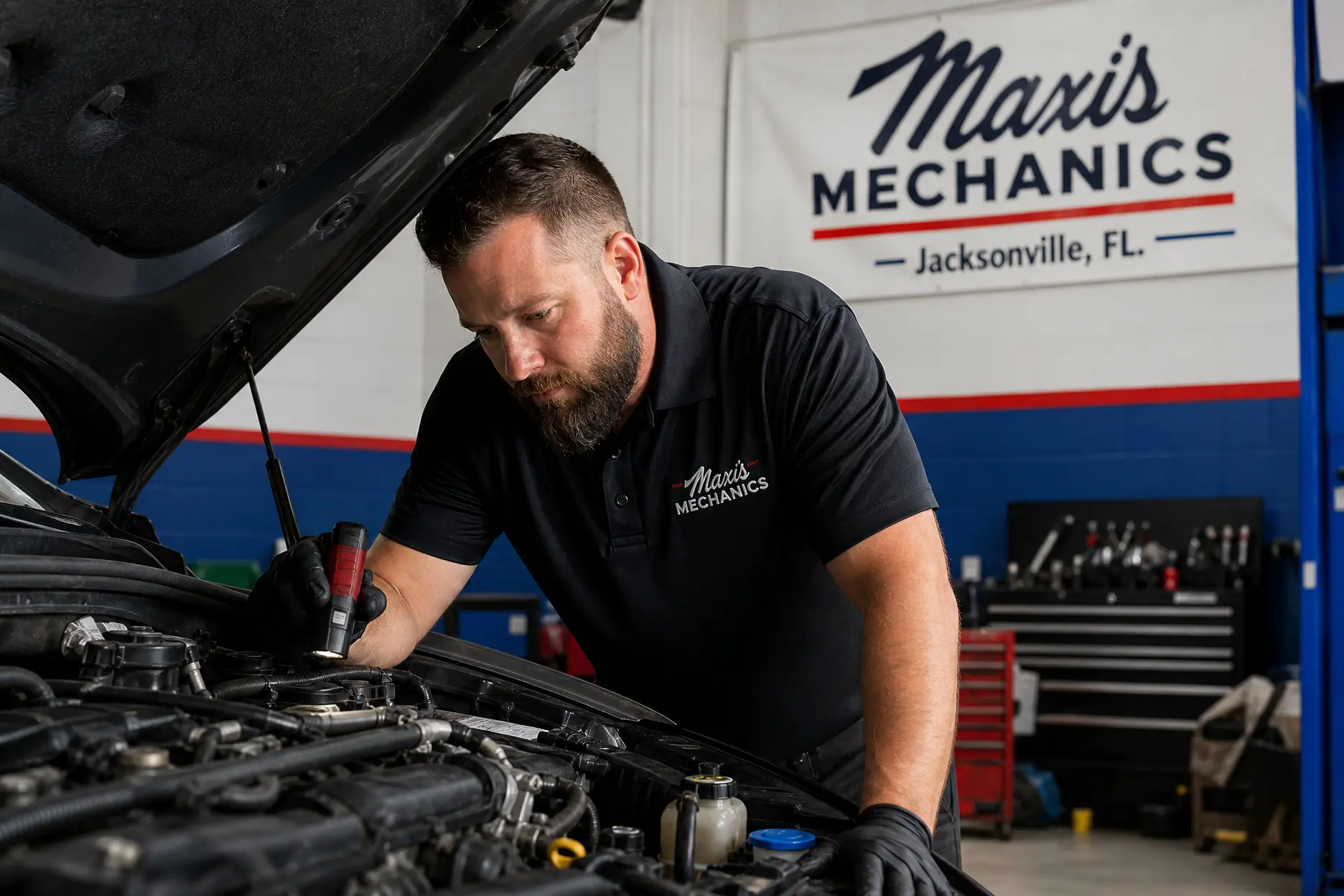
What Are the Warning Signs of a Failing Tie Rod?
The most common bad tie rod symptoms include unusual tire wear, loose or wandering steering, vibration in the steering wheel, and clunking noises when turning. These signs indicate the tie rod end has developed excessive play or is separating from its connection point.[3]
Uneven tire wear, particularly feathering on the inner or outer edges, occurs because a worn tie rod allows the wheel alignment to shift constantly during driving. You might notice your vehicle pulls to one side even on straight roads, or that the steering wheel feels loose with more play than normal before the wheels respond. A clunking or knocking sound when turning at low speeds — common in parking lots — indicates the ball joint inside the tie rod end has worn to the point of metal-on-metal contact. If you feel vibration or shimmy in the steering wheel, especially at highway speeds, the tie rod may be loose enough to allow the wheel to oscillate slightly.
In severe cases, you might see visible damage during a visual inspection: torn rubber boots exposing the ball joint, rust accumulation around the tie rod end, or even visible separation between components. Any of these signs warrants immediate professional inspection, as they indicate the tie rod could fail completely without warning.[4]
What Happens If a Tie Rod Fails While Driving?
If a tie rod breaks completely while driving, you will lose steering control of that wheel, making the vehicle extremely difficult or impossible to steer. The affected wheel will typically turn outward suddenly, and the steering wheel will feel completely loose with no resistance.[5]
Complete tie rod failure is a catastrophic mechanical event. The wheel on the failed side will no longer respond to steering input and may point in a random direction determined by road forces and suspension geometry. At highway speeds, this can cause the vehicle to veer sharply, potentially into oncoming traffic or off the road. Even at lower speeds, a broken tie rod makes controlled steering nearly impossible, turning routine maneuvers like lane changes or turns into dangerous situations.
The severity of the outcome depends on which tie rod fails, your speed, and traffic conditions, but all scenarios present serious crash risk. This is why automotive safety experts and organizations like the National Highway Traffic Safety Administration emphasize that steering component failure represents one of the most dangerous mechanical failures a vehicle can experience.[6] Unlike brake failure, where you can often slow down using engine braking or the parking brake, steering failure leaves you with virtually no ability to control your vehicle’s direction.
How Long Can You Drive With a Bad Tie Rod?
You should not drive any significant distance with a bad tie rod — only far enough to safely reach a repair facility, ideally on low-speed roads. There is no safe timeline for continued driving because the progression from “worn” to “failed” is unpredictable and can happen suddenly.
While some drivers report operating vehicles with early-stage tie rod wear for weeks or even months, this is extremely risky behavior that puts everyone on the road in danger. The tie rod end’s internal components degrade progressively, but the final failure often happens abruptly when the remaining material finally gives way under stress. Factors like potholes, sharp turns, or even regular steering input can trigger the final break.
Jacksonville’s roads, with their mix of highway speeds, urban traffic, and occasional rough pavement, make driving with compromised steering components particularly hazardous. If you notice any signs of a failing tie rod, the only safe course of action is to have your vehicle towed or driven directly to a qualified repair facility at low speeds on side streets, avoiding highways and heavy traffic. The cost of tie rod replacement is minimal compared to the potential consequences of steering failure.
How Do Mechanics Test for Tie Rod Wear?
ASE-certified technicians test tie rods by physically checking for play in the tie rod ends while the vehicle is lifted and by inspecting the boots for damage. The standard procedure involves grasping the tire at the 3 and 9 o’clock positions and pushing/pulling to feel for any movement in the steering linkage.[7]
During a proper suspension inspection, the technician will raise the vehicle on a lift and manually manipulate each front wheel to isolate movement in the steering components. Excessive play — even a few millimeters — in the tie rod end indicates wear that compromises steering precision and safety. The mechanic will also visually inspect the rubber boots that protect the ball joints; torn boots allow contaminants in and lubricant out, accelerating wear even if the joint isn’t yet loose.
Many shops include tie rod inspection as part of alignment services, since worn tie rods prevent proper alignment and cause rapid tire wear. A comprehensive steering and suspension inspection typically examines both inner and outer tie rods, along with related components like ball joints, control arms, and the steering rack. At Maxi’s Mechanics, our ASE-certified technicians follow manufacturer specifications and industry best practices to accurately diagnose tie rod condition and recommend replacement only when genuinely necessary.
Schedule service at your nearest Maxi’s Mechanics location in Jacksonville — call (904) 646-4000 or book online at maxiautorepair.com.
What Does Tie Rod Replacement Cost and Involve?
Tie rod replacement typically costs between $150 and $400 per side, including parts and labor, and requires a wheel alignment afterward. The total cost depends on whether you’re replacing inner tie rods, outer tie rods, or both, and your vehicle’s specific configuration.[8]
| Component | Typical Cost Range | Labor Time | Alignment Required |
|---|---|---|---|
| Outer Tie Rod (one side) | $100–$250 | 0.5–1.0 hours | Yes |
| Inner Tie Rod (one side) | $150–$300 | 1.0–1.5 hours | Yes |
| Complete Tie Rod Assembly | $200–$400 | 1.5–2.0 hours | Yes |
| Wheel Alignment (4-wheel) | $75–$150 | 0.5–1.0 hours | N/A |
The replacement process involves removing the wheel, disconnecting the tie rod end from the steering knuckle using a special separator tool, and installing the new component. Inner tie rod replacement is more labor-intensive because it often requires removing the outer tie rod first and may involve accessing the steering rack boot. After installation, a four-wheel alignment is essential to ensure proper steering geometry and prevent premature tire wear. The new tie rod ends come with fresh grease and intact boots, restoring full steering precision and safety. Most shops recommend replacing tie rods in pairs (both sides) to ensure balanced steering response, though single-side replacement is acceptable if only one shows wear.
Frequently Asked Questions
Can a bad tie rod cause my car to shake?
Yes, a worn tie rod can cause steering wheel vibration or shimmy, especially at highway speeds. The looseness in the tie rod end allows the wheel to oscillate slightly, transmitting vibration through the steering system.Will a bad tie rod make noise?
A failing tie rod typically produces a clunking or knocking sound when turning, particularly at low speeds in parking lots. The noise comes from excessive play in the worn ball joint as it shifts under steering load.Can I replace just one tie rod or do I need to replace both sides?
You can replace a single tie rod if only one side is worn, but many mechanics recommend replacing both sides together since they wear at similar rates. Replacing both ensures balanced steering response and avoids a second repair visit soon after.How long do tie rods typically last?
Tie rods generally last 70,000 to 100,000 miles under normal driving conditions, though this varies based on road conditions, driving style, and climate. Jacksonville drivers may experience faster wear due to humidity, salt air near the coast, and road conditions.Does insurance cover tie rod replacement?
Standard auto insurance typically does not cover tie rod replacement because it’s considered normal wear-and-tear maintenance rather than accident damage. However, if the tie rod was damaged in a covered collision, your policy may cover the repair as part of the claim.Don’t risk your safety or the safety of others by driving on worn steering components. At the first sign of tie rod problems — loose steering, unusual tire wear, or clunking noises — bring your vehicle to Maxi’s Mechanics for a professional inspection. Schedule service at your nearest Maxi’s Mechanics location in Jacksonville — call (904) 646-4000 or book online at maxiautorepair.com.
Written by The Team at Maxi’s Mechanics — Maxi’s Mechanics is a veteran-owned, ASE-certified auto repair shop serving Jacksonville, FL since 2003, with four locations: Beach Blvd, Riverside, Hodges, and San Marco. Updated January 2026.
References
- National Highway Traffic Safety Administration. Steering Systems and Components. https://www.nhtsa.gov/
- Automotive Service Excellence (ASE). Suspension and Steering Certification Guide. https://www.ase.com/
- Car Care Council. Steering and Suspension System Maintenance. https://www.carcare.org/
- Society of Automotive Engineers (SAE). Steering Linkage Inspection Standards. https://www.sae.org/
- National Highway Traffic Safety Administration. Vehicle Crash Causation Study. https://www.nhtsa.gov/
- Insurance Institute for Highway Safety. Mechanical Failure and Crash Risk. https://www.iihs.org/
- Automotive Service Excellence (ASE). Suspension and Steering Diagnosis Procedures. https://www.ase.com/
- Automotive Aftermarket Industry Association. Labor Time and Parts Pricing Guide. https://www.aftermarket.org/