Is It Risky to Drive with a Bad Transmission?
Driving with a failing transmission is extremely risky and can lead to complete transmission failure, costly repairs exceeding $3,500, and dangerous roadside breakdowns. Maxi’s Mechanics in Jacksonville, FL advises stopping operation immediately when symptoms appear — continued driving accelerates damage and compromises safety.
Driving with a bad transmission is not safe and should be avoided whenever possible. A failing transmission can strand you in traffic, cause loss of vehicle control, and turn a $800 repair into a $4,000 replacement.[1] The moment you notice transmission problems, limiting your driving and seeking immediate diagnosis protects both your safety and your wallet.
Written by The Team at Maxi’s Mechanics — Maxi’s Mechanics is a veteran-owned, ASE-certified auto repair shop serving Jacksonville, FL since 2003, with four locations: Beach Blvd, Riverside, Hodges, and San Marco.
What Are the Immediate Risks of Driving with a Bad Transmission?
The most immediate risks include sudden loss of power, inability to accelerate in traffic, and complete transmission lockup while driving. When a transmission fails mid-operation, your vehicle may shift into neutral unexpectedly, leaving you without power to merge or climb hills safely.[2] In Jacksonville’s high-speed corridors like I-95 and I-295, losing acceleration capability creates collision hazards.
Thermal damage escalates rapidly once transmission symptoms begin. Normal transmission operating temperature ranges from 175°F to 225°F, but a failing unit can exceed 260°F within minutes of highway driving.[3] Overheated transmission fluid loses its lubricating properties, causing clutch pack friction material to glaze and internal seals to fail. What might have been a $600 solenoid replacement becomes a $3,800 rebuild because metal debris circulates through the system, scoring valve bodies and pump components.
Roadside breakdowns pose serious safety concerns. A transmission that fails on Beach Boulevard during rush hour or on the Buckman Bridge leaves you in a vulnerable position with limited shoulder space. Florida’s heat compounds the danger — waiting for a tow truck in 95°F weather with no air conditioning creates health risks, especially for children and elderly passengers.

What Symptoms Indicate Your Transmission Is Failing?
Bad transmission symptoms include delayed engagement, slipping between gears, grinding or whining noises, burning odors, and dashboard warning lights. Delayed engagement occurs when you shift from Park to Drive and the vehicle hesitates 2-3 seconds before moving — a clear sign of low hydraulic pressure or worn clutch packs.[4]
Slipping gears manifest as unexpected RPM increases without corresponding acceleration, or the engine revving while the vehicle loses speed. This happens when clutch friction surfaces wear beyond specification and can no longer hold torque. Automatic transmissions rely on precise hydraulic pressure, typically 60-150 PSI depending on gear, and worn components reduce clamping force below safe thresholds.[1]
Audible warnings include grinding during shifts, whining that changes pitch with vehicle speed, or clunking when changing gears. Grinding indicates synchronizer wear in manual transmissions or planetary gear damage in automatics. A high-pitched whine suggests pump bearing failure or low fluid level. Burning smells signal overheated fluid — healthy transmission fluid is bright red; burned fluid turns brown or black and smells acrid.
Dashboard warning lights provide electronic confirmation. The Check Engine light may trigger with transmission-related codes P0700 through P0799, while dedicated transmission temperature warnings indicate fluid exceeding 260°F. Modern vehicles with transmission range sensors will illuminate specific gear indicator lights when internal faults are detected.
How Does Continued Driving Worsen Transmission Damage?
Every mile driven with a failing transmission accelerates wear exponentially because metal debris circulates through the system, damaging previously healthy components. When a clutch pack fails, it sheds friction material particles that contaminate the entire fluid supply. These particles act as abrasives, scoring valve body surfaces and clogging filter screens.[5]
Hydraulic pressure loss creates a cascading failure pattern. A transmission requires precise pressure regulation — for example, second gear might need 85 PSI while fourth gear requires 120 PSI. When seals leak or pump output drops, the transmission control module compensates by increasing clutch engagement time, which generates excess heat. This heat further degrades seals, creating a feedback loop that progresses from minor slippage to complete failure within days of continued operation.
The financial impact grows dramatically with delay. Catching a transmission problem at the solenoid stage costs $400-$800 for parts and labor. Waiting until clutch packs burn requires a rebuild at $2,500-$3,800. Continuing to drive after complete failure often damages the torque converter, valve body, and hard parts, pushing costs to $4,500-$6,000 for replacement with a remanufactured unit.[1] In Jacksonville’s stop-and-go traffic on Atlantic Boulevard or Baymeadows Road, heat buildup compounds these issues faster than in highway-only driving.
Can You Drive Short Distances with Transmission Problems?
You can drive short distances to reach a repair facility only if the transmission still engages all gears without slipping and shows no signs of overheating. Limit travel to under 5 miles at speeds below 35 mph, avoid hills and highway merging, and monitor fluid temperature if your vehicle has a gauge.[2]
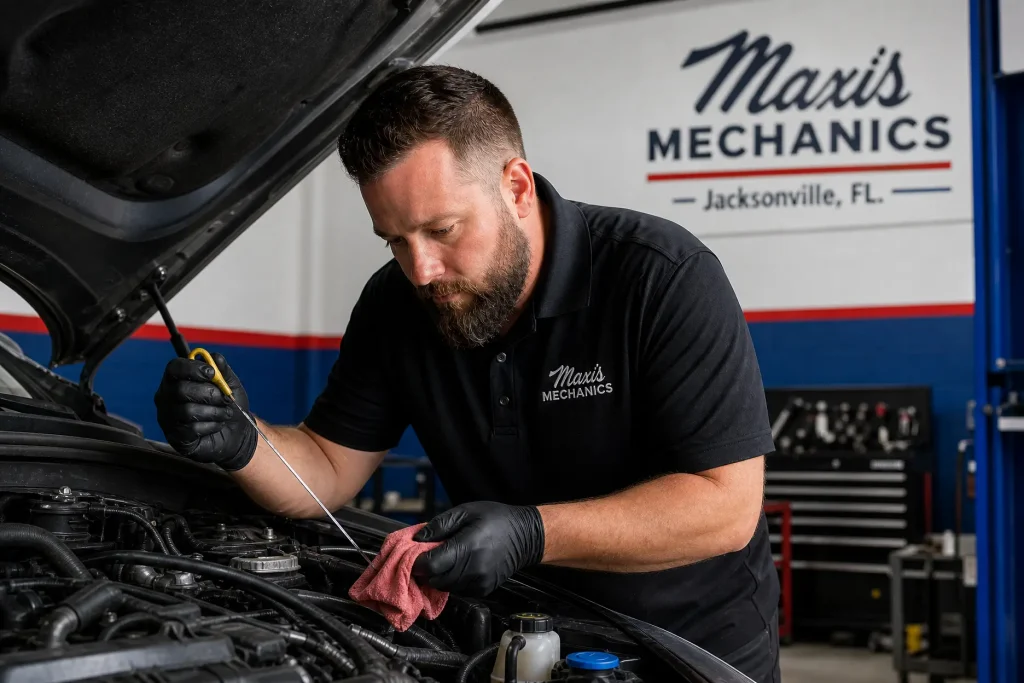
Before attempting even short trips, check transmission fluid level and condition. Park on level ground, run the engine until warm, and check the dipstick with the engine running and transmission in Park. Fluid should be bright red and at the “Full Hot” mark. Dark brown or black fluid with a burnt smell means internal damage has already occurred — do not drive; arrange for towing. Low fluid (more than 1 quart down) indicates a leak that will cause immediate failure under load.
Emergency transport to a shop requires specific precautions. Use hazard lights, stay in the right lane, and avoid sudden acceleration. Do not use overdrive or higher gears if you have a manual shift option. If the vehicle begins slipping, emitting smoke, or losing power, pull over immediately and call for a tow. The cost of a 10-mile tow ($75-$125 in Jacksonville) is negligible compared to turning a $1,200 repair into a $4,000 replacement by continuing to drive.
What Is the Difference Between Minor and Major Transmission Failure?
Minor transmission failures involve external components like solenoids, sensors, or fluid leaks, while major failures indicate internal damage to clutch packs, bands, or hard parts. This distinction determines whether repair is possible or full replacement becomes necessary.[4]
| Failure Type | Symptoms | Typical Repair Cost | Drive Risk Level |
|---|---|---|---|
| Minor (External) | Slow leaks, single gear issue, occasional hard shifts | $300-$900 | Moderate — can drive to shop with caution |
| Moderate (Hydraulic) | Delayed engagement, multiple gear slip, whining noise | $1,200-$2,000 | High — limit to emergency transport only |
| Major (Internal) | No engagement, grinding, burning smell, metal debris | $2,800-$4,500 | Severe — do not drive, arrange towing |
| Catastrophic | Complete loss of function, locked gears, fluid leaking rapidly | $4,000-$6,500 | Extreme — vehicle inoperable, tow immediately |
Minor failures caught early often involve replacement of shift solenoids ($250-$600), output speed sensors ($200-$400), or external seal repairs ($300-$700). These components can fail without contaminating the internal fluid system. Diagnostic trouble codes like P0715 (Input/Turbine Speed Sensor) or P0753 (Shift Solenoid A) indicate addressable electrical issues rather than mechanical destruction.[6]
Major failures show evidence of internal wear. Metal shavings on the dipstick, dark contaminated fluid, or pan debris during inspection confirm that friction surfaces have deteriorated. At this stage, partial repairs are inadvisable because remaining debris will damage new components. A complete rebuild or replacement becomes the only reliable solution.
When Should You Stop Driving Immediately?
Stop driving immediately if you experience complete loss of gear engagement, smell burning transmission fluid, see fluid leaking rapidly, or notice smoke from under the vehicle. These conditions indicate catastrophic failure that creates both safety hazards and risks total transmission destruction.[5]
A burning smell means fluid temperature has exceeded 280°F, at which point organic compounds in the ATF break down and clutch friction material begins to carbonize. Continued operation at these temperatures causes permanent damage within minutes. If you detect this smell while driving in Jacksonville, pull into the nearest safe parking area — gas stations, shopping centers, or wide shoulders — and shut off the engine immediately.
Fluid leaking rapidly (more than a few drops per minute) will cause complete failure before you can reach a repair shop. Automatic transmissions contain 10-16 quarts of fluid, and losing just 2 quarts drops hydraulic pressure below the minimum threshold for clutch engagement. A visible puddle forming under your parked car or fluid actively dripping while driving requires immediate towing.
Loss of all forward gears while reverse still functions, or vice versa, indicates specific internal failures that will not improve. In these cases, the transmission control module may enter “limp mode,” limiting you to second or third gear only. While limp mode allows minimal movement, continuing to drive damages the remaining functional components and should only be used to reach the nearest safe stopping point within 1-2 miles.
Schedule service at your nearest Maxi’s Mechanics location in Jacksonville — call (904) 646-4000 or book online at maxiautorepair.com.
Frequently Asked Questions
How long can you drive with a slipping transmission?
You should not drive more than 5-10 miles with a slipping transmission, and only at low speeds to reach a repair facility. Continued driving with slippage generates excessive heat that accelerates damage, often turning a $1,200 repair into a $4,000 replacement within days.
Will low transmission fluid cause permanent damage?
Yes, operating with low transmission fluid causes permanent damage within minutes of driving. Insufficient fluid creates metal-on-metal contact, scores internal surfaces, and generates heat exceeding 300°F. Even brief operation 2 quarts low can require a full rebuild rather than simply topping off fluid.
Can a bad transmission cause your car to shut off while driving?
A failing transmission typically will not shut off the engine but can cause sudden loss of power to the wheels, making it feel like a stall. In vehicles with electronically controlled systems, severe transmission faults may trigger limp mode or cause the engine to enter a reduced power state as a safety measure.
Is it better to repair or replace a failing transmission?
Repair is more cost-effective for minor issues like solenoid replacement ($400-$900) or external leaks ($300-$700), while replacement becomes necessary when internal components show wear or metal contamination is present. A quality rebuild costs $2,500-$3,800, while a remanufactured replacement runs $3,500-$5,500 installed, making repair the better option when caught early.
What transmission problems can be fixed without a rebuild?
Transmission problems addressable without a rebuild include fluid and filter changes, shift solenoid replacement, speed sensor replacement, external seal repairs, and transmission mount replacement. These solutions work only when internal components remain undamaged and fluid shows no contamination or metal debris.
Transmission problems demand immediate attention to prevent safety risks and costly damage. The moment you notice delayed shifts, slipping gears, or unusual noises, professional diagnosis becomes critical. What starts as a $500 repair can escalate to a $5,000 replacement if ignored, and the risk of roadside breakdown in Jacksonville traffic adds urgency to the decision.
Written by The Team at Maxi’s Mechanics — Maxi’s Mechanics is a veteran-owned, ASE-certified auto repair shop serving Jacksonville, FL since 2003, with four locations: Beach Blvd, Riverside, Hodges, and San Marco. Updated January 2026.
References
- Automatic Transmission Rebuilders Association. Transmission Failure Costs and Prevention. https://www.atra.com/
- National Highway Traffic Safety Administration. Vehicle Safety: Transmission System Defects. https://www.nhtsa.gov/
- Society of Automotive Engineers. Transmission Fluid Temperature Standards SAE J306. https://www.sae.org/
- Automotive Service Excellence (ASE). Automatic Transmission Service and Repair Guidelines. https://www.ase.com/
- Car Care Council. Transmission Maintenance and Failure Prevention Guide. https://www.carcare.org/
- International Automotive Technicians Network. OBD-II Transmission Diagnostic Codes. https://www.iatn.net/