R1234yf vs R134a: Understanding Your Car’s AC Refrigerant
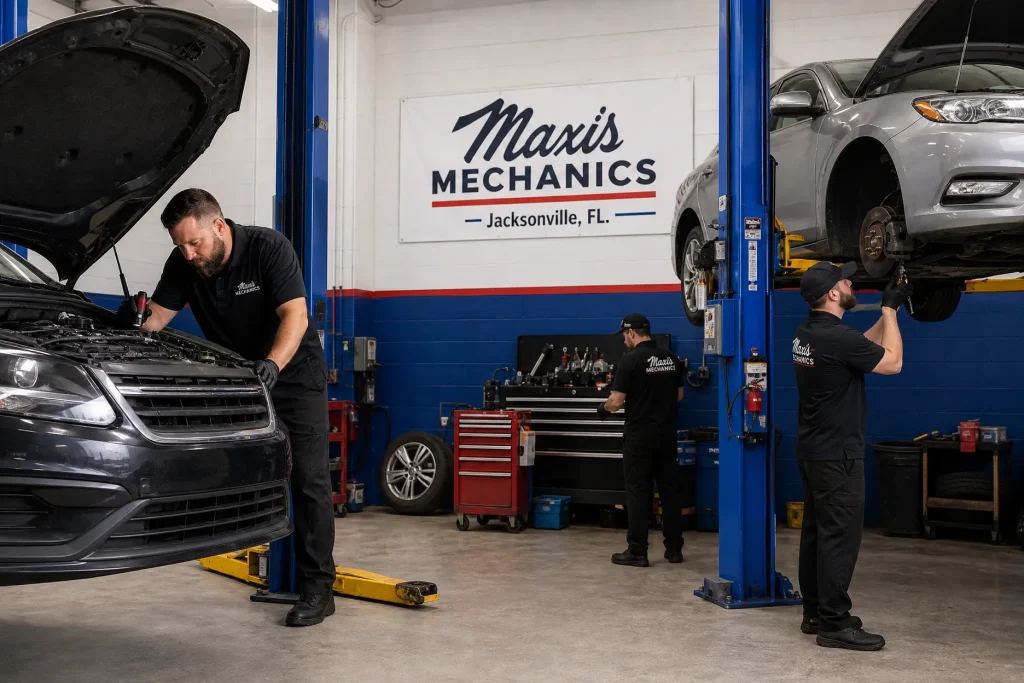
R1234yf and R134a are distinct automotive air conditioning refrigerants that are not interchangeable. Maxi’s Mechanics in Jacksonville, FL identifies the correct refrigerant for your vehicle using VIN lookups and underhood labels, ensuring EPA-compliant AC service across all four of our ASE-certified locations.
R134a dominated automotive AC systems from 1994 through 2016, while R1234yf became the new standard for most vehicles manufactured after 2017 due to environmental regulations. The two refrigerants require different equipment, oils, and handling procedures, making proper identification critical before any AC service. Your vehicle uses one or the other — never a mixture — and using the wrong refrigerant can damage compressor seals, reduce cooling performance, and violate federal law.[1]
Written by The Team at Maxi’s Mechanics — Maxi’s Mechanics is a veteran-owned, ASE-certified auto repair shop serving Jacksonville, FL since 2003, with four locations: Beach Blvd, Riverside, Hodges, and San Marco.
What Is the Main Difference Between R1234yf and R134a?
R1234yf has a global warming potential (GWP) of 4, while R134a has a GWP of 1,430 — making the newer refrigerant 99.7% less harmful to the atmosphere. This environmental advantage drove the EPA and international regulators to mandate R1234yf for new vehicles starting in model year 2017, though some manufacturers began the transition as early as 2013.[2]
The chemical formulas differ slightly: R134a is 1,1,1,2-tetrafluoroethane, while R1234yf is 2,3,3,3-tetrafluoropropene. That single molecular variation gives R1234yf a much shorter atmospheric lifespan — 11 days versus 13 years for R134a — which explains the dramatic GWP reduction.[3] Both refrigerants cool effectively at similar pressures, but R1234yf costs significantly more due to patent protections and limited production capacity.

How Do I Know Which Refrigerant My Car Uses?
Check the underhood label on your AC system or the driver’s door jamb sticker — these labels will display either “R134a” or “R1234yf” along with the system capacity in ounces. If the label is missing or illegible, your vehicle identification number (VIN) provides definitive confirmation through manufacturer databases that ASE-certified shops access during diagnostic appointments.[4]
Model year serves as a general guideline: vehicles built before 2013 use R134a, while most 2018-and-newer models use R1234yf. The 2013-2017 window represents a transition period where manufacturers phased in the new refrigerant gradually, so individual confirmation is essential. Luxury brands like BMW, Mercedes-Benz, and Jaguar adopted R1234yf earlier than domestic mass-market manufacturers. At our Jacksonville locations, we verify refrigerant type before connecting any service equipment to prevent cross-contamination that damages recovery machines.
Can I Convert My R134a System to R1234yf?
No, retrofitting an R134a system to R1234yf is neither legal nor practical due to incompatible compressor oils, different pressure specifications, and EPA regulations prohibiting refrigerant mixing. The two refrigerants use different polyalkylene glycol (PAG) oil formulations: R134a systems require PAG 46 or PAG 100, while R1234yf systems use specialized PAG oils designed for the newer refrigerant’s chemistry.[5]
Beyond oil incompatibility, R1234yf systems include additional safety features like pressure sensors and specific hose materials to address the refrigerant’s mild flammability classification. Converting would require replacing the compressor, condenser, hoses, expansion valve, and all seals — essentially rebuilding the entire AC system at a cost exceeding the value of most older vehicles. If your R134a system needs major repairs, continuing with R134a remains the cost-effective choice. The refrigerant remains widely available and legal for servicing existing systems indefinitely.
What Are the Cost Differences for AC Recharge Services?
R1234yf recharge services typically cost $150 to $300, while R134a recharges range from $100 to $180, with the price gap driven entirely by refrigerant material costs. R1234yf wholesale pricing runs $70 to $100 per pound compared to $25 to $40 per pound for R134a, though these prices fluctuate with supply conditions.[6]
| Factor | R134a Systems | R1234yf Systems |
|---|---|---|
| Refrigerant Cost | $25–$40/lb | $70–$100/lb |
| Typical System Capacity | 1.5–2.5 lbs | 1.0–1.8 lbs |
| Recharge Service | $100–$180 | $150–$300 |
| Leak Repair Parts | Widely available, lower cost | Limited sources, 20–40% premium |
| Equipment Required | Standard recovery machine | Dedicated R1234yf machine |
Labor costs remain similar between the two systems since the diagnostic and service procedures follow the same principles. The equipment separation requirement — EPA regulations mandate dedicated recovery machines for each refrigerant type — adds overhead for shops serving both systems, but Jacksonville’s humid climate keeps AC work steady enough that we maintain certified equipment for both standards.[1] System capacity matters too: R1234yf systems generally hold 20-30% less refrigerant by weight than comparable R134a systems, partially offsetting the higher per-pound cost.
Schedule service at your nearest Maxi’s Mechanics location in Jacksonville — call (904) 646-4000 or book online at maxiautorepair.com.
Why Did the Automotive Industry Switch to R1234yf?
The European Union’s MAC Directive mandated that all new vehicles sold after 2017 use refrigerants with a GWP below 150, effectively banning R134a and forcing global manufacturers to adopt R1234yf. U.S. regulations followed suit through EPA SNAP (Significant New Alternatives Policy) rules and CAFE (Corporate Average Fuel Economy) standards that incentivize low-GWP refrigerants through emissions credits.[2]
Automakers initially explored CO2 (R744) as an alternative, and some European manufacturers still offer CO2 systems in select models. However, CO2 requires operating pressures five times higher than R134a, demanding expensive specialized components that increase vehicle manufacturing costs. R1234yf offered a drop-in-similar solution: it works at comparable pressures to R134a, requires minimal system redesign, and delivers equivalent cooling performance. The primary challenges were cost and mild flammability — R1234yf earned a Class 2L flammability rating, meaning it ignites only under specific conditions that are extremely rare in normal operation or collision scenarios.[7]
Frequently Asked Questions
Will R134a be banned or phased out?
R134a remains legal for servicing existing vehicles indefinitely, but EPA regulations prohibit its use in new passenger vehicles manufactured after model year 2021. The refrigerant continues to be produced and distributed for retrofit and maintenance of the millions of pre-2018 vehicles still on the road.Is R1234yf dangerous because it’s flammable?
R1234yf has a Class 2L “mildly flammable” rating requiring specific ignition conditions (open flame, temperatures above 405°F, and sustained exposure) that rarely occur in real-world scenarios. SAE and independent testing confirm that collision fire risk is negligible, and no field incidents have been documented in over a decade of use.Can I recharge my own AC system with refrigerant from an auto parts store?
EPA Section 609 regulations require certification to purchase and handle both R134a and R1234yf, with R1234yf carrying stricter restrictions due to cost and safety considerations. DIY recharge kits sold at retail contain R134a only and are limited to small cans, making them unsuitable for complete system service or any R1234yf vehicle.How often should I recharge my car’s AC refrigerant?
A properly functioning AC system never needs refrigerant added — it’s a closed loop. If your system requires a recharge, you have a leak that should be diagnosed and repaired. Annual recharges indicate an unresolved leak that wastes money and releases regulated refrigerants into the atmosphere in violation of EPA rules.Understanding the differences between R1234yf and R134a helps you make informed decisions about AC service and avoid costly mistakes. At Maxi’s Mechanics, our ASE-certified technicians use manufacturer-approved equipment and EPA-compliant procedures for both refrigerant types across our four Jacksonville locations. Schedule service at your nearest Maxi’s Mechanics location in Jacksonville — call (904) 646-4000 or book online at maxiautorepair.com.
Written by The Team at Maxi’s Mechanics — ASE-certified auto repair serving Jacksonville, FL since 2003. Updated January 2026.
References
- U.S. Environmental Protection Agency. Refrigerant Management Requirements Under Section 608 and 609. https://www.epa.gov/section608
- U.S. Environmental Protection Agency. SNAP Regulations and Acceptable Refrigerants. https://www.epa.gov/snap
- Society of Automotive Engineers. J2845: R-1234yf Equipment Specifications. https://www.sae.org/standards/content/j2845/
- Mobile Air Climate Systems Association. Refrigerant Identification Guide. https://www.macs.org
- SAE International. Automotive Refrigerant Oil Compatibility Standards. https://www.sae.org
- Automotive Service Association. 2025 Refrigerant Pricing and Service Cost Survey. https://www.asashop.org
- SAE International. CRP1234: R-1234yf Safety Study. https://www.sae.org/standards/content/crp1234/