Pre-Trip Car Inspection Checklist: Essential Checks Before Summer Road Trips
A pre-trip car inspection checklist ensures your vehicle’s fluids, tires, brakes, cooling system, battery, and lights are road-ready before long-distance travel. Maxi’s Mechanics in Jacksonville, FL performs comprehensive pre-trip inspections at four locations across Beach Blvd, Riverside, Hodges, and San Marco, helping Florida drivers avoid breakdowns during summer vacation travel.
A pre-trip car inspection checklist should cover fluids, tires, brakes, battery, cooling system, belts, hoses, and lights — the core systems most likely to fail during extended highway driving in summer heat. Checking these components 1-2 weeks before departure gives you time to schedule repairs and avoid roadside emergencies in unfamiliar locations.
Written by The Team at Maxi’s Mechanics — Maxi’s Mechanics is a veteran-owned, ASE-certified auto repair shop serving Jacksonville, FL since 2003, with four locations: Beach Blvd, Riverside, Hodges, and San Marco.
Why Do You Need a Pre-Trip Car Inspection Before Summer Travel?
Pre-trip car inspections identify wear patterns and marginal components that operate fine locally but fail under the sustained load of highway driving — conditions like constant high-speed operation, elevated under-hood temperatures, and multi-hour run times expose weaknesses that short commutes never stress.[1] Summer heat amplifies these risks: Jacksonville temperatures routinely exceed 90°F from June through September, raising engine bay temperatures 30-40°F above ambient and accelerating coolant evaporation, battery fluid loss, and belt deterioration.[2]
The AAA Emergency Road Service network responds to over 32 million breakdowns annually, with battery failures, tire issues, and overheating comprising 58% of summer service calls.[3] Most of these failures are detectable through visual inspection and basic testing 1-2 weeks before travel. A professional inspection typically costs $50-100 but identifies problems while you’re near trusted shops with competitive pricing — versus emergency repairs at unfamiliar facilities charging premium rates plus towing fees averaging $125-250 per incident.[4]
What Should You Check in Your Engine Compartment?
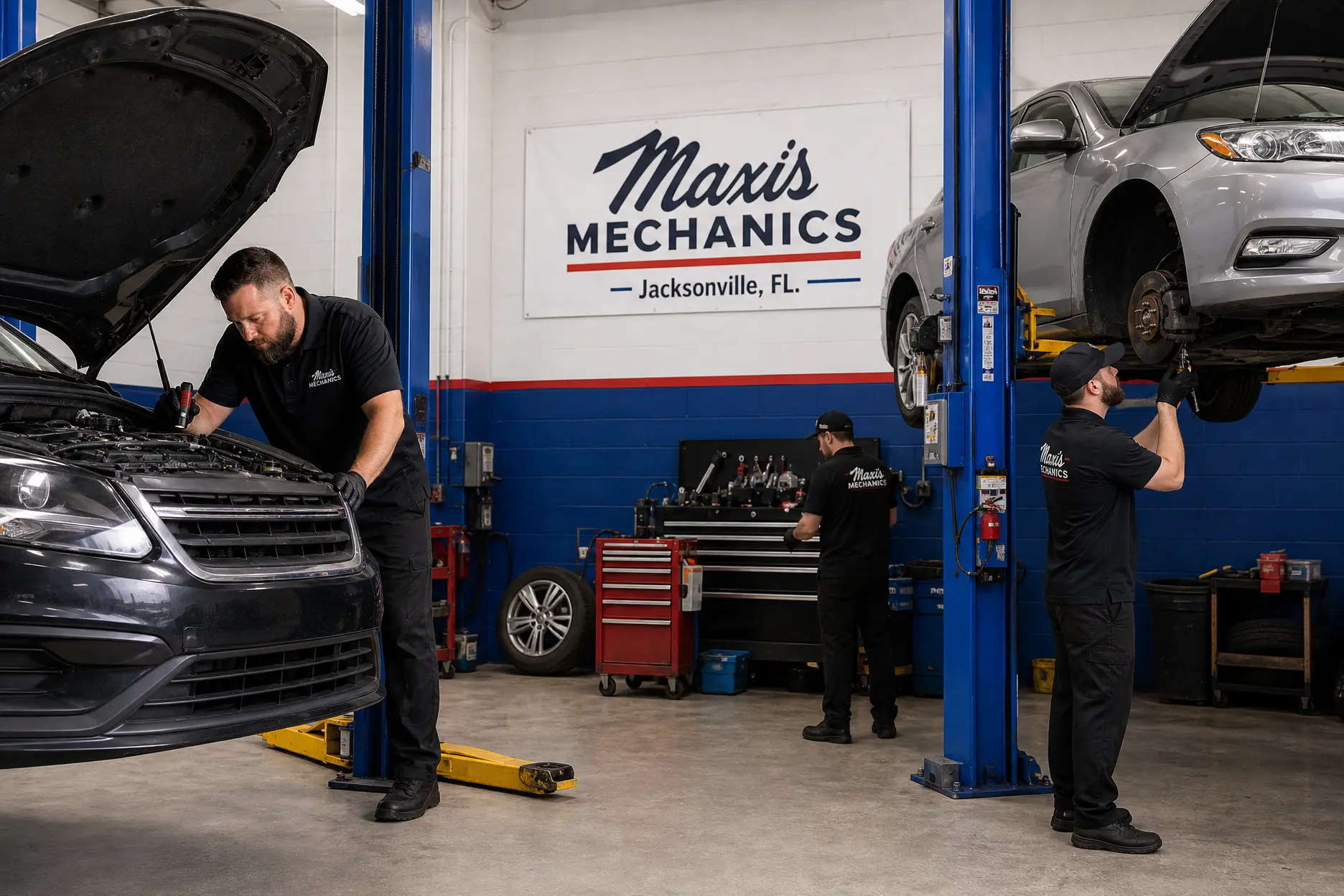
Engine oil level and condition, coolant level and concentration, brake fluid, power steering fluid, and windshield washer fluid all require verification before long trips. Check engine oil with the engine cold and vehicle on level ground: the dipstick should read between the MIN and MAX marks, and oil should appear amber to light brown.[1] Dark black oil or oil below the MIN mark indicates you’re overdue for service.
Coolant requires both level and concentration checks. The overflow reservoir should read between LOW and FULL marks when cold, and fluid should appear bright green, orange, or pink depending on coolant type — never rusty brown.[5] Concentration testing with a refractometer ensures proper freeze/boil protection: most coolants require 50/50 antifreeze-to-water ratios providing -34°F freeze protection and 265°F boil protection. Jacksonville doesn’t see freezing temperatures, but boilover protection matters during stop-and-go traffic in 95°F heat with humidity above 70%.
Inspect all drive belts for cracking, glazing, or fraying along the ribs. Serpentine belts typically last 60,000-100,000 miles but deteriorate faster in Florida’s heat and humidity.[1] Check all rubber hoses for soft spots, bulges, or seepage at clamp connections — hoses under pressure often fail at their weakest point during sustained highway operation.
How Do You Inspect Tires for Road Trip Readiness?
Tire inspection requires checking tread depth, inflation pressure, sidewall condition, and age — all four tires plus the spare. Measure tread depth at multiple points across each tire using a tread depth gauge: the legal minimum is 2/32″, but safe wet-weather performance requires at least 4/32″.[6] Use the penny test as a quick field check: insert a penny into the tread with Lincoln’s head upside down — if you see the top of his head, the tire has less than 2/32″ remaining and needs replacement.
Check inflation pressure when tires are cold (driven less than one mile) using an accurate digital gauge. The correct pressure appears on the driver’s door jamb placard, not the maximum pressure molded into the tire sidewall.[6] Under-inflation by just 10 psi increases tire temperature, accelerates tread wear, and reduces fuel economy by 3-5%. Over-inflation creates harsh ride quality and reduces the contact patch, compromising wet traction.
| Component | Inspection Point | Replace If | Typical Interval |
|---|---|---|---|
| Tires | Tread depth, pressure, sidewalls | <4/32″ tread or 6+ years old | 40,000-70,000 miles |
| Battery | Terminals, voltage, load test | <12.4V resting or 3+ years old | 3-5 years (Florida heat) |
| Brake Pads | Thickness, wear indicators | <3mm thickness remaining | 30,000-70,000 miles |
| Coolant | Level, color, concentration | Rusty/brown or low protection | 30,000-150,000 miles |
| Serpentine Belt | Cracks, glazing, tension | Visible cracks or 6+ years old | 60,000-100,000 miles |
Examine sidewalls for cuts, bulges, or weather checking (fine cracks in the rubber). Check the DOT date code on each tire: the last four digits indicate week and year of manufacture (e.g., “2319” means the 23rd week of 2019).[6] Replace tires over six years old regardless of tread depth, as rubber compounds degrade with age and heat exposure. Don’t forget the spare tire — verify it holds proper pressure and isn’t age-expired.
What Brake System Checks Are Essential Before Long Trips?
Brake pad thickness, rotor condition, fluid level, and pedal feel all require verification before highway travel. Most vehicles allow visual inspection of front brake pads through the wheel spokes: pads should have at least 3mm (roughly 1/8″) of friction material remaining above the backing plate.[7] If pads appear thin or you hear squealing during braking, schedule inspection immediately — worn pads damage rotors and increase stopping distances.
Brake fluid should appear clear to light amber and reach the MAX line on the master cylinder reservoir. Dark or cloudy fluid indicates moisture contamination, which lowers the boiling point and can cause brake fade during repeated hard stops on mountain grades.[7] Most manufacturers recommend flushing brake fluid every 3 years or 45,000 miles, whichever comes first. Test pedal feel with the engine running: the pedal should feel firm and hold steady pressure without sinking toward the floor.
How Do You Check Your Cooling System for Summer Travel?
The cooling system requires checking coolant level and condition, hose integrity, radiator cap function, and thermostat operation before summer road trips. Visually inspect the radiator and condenser fins for debris, bent fins, or blockage — reduced airflow through the radiator stack causes overheating in slow traffic.[5] Check for coolant stains or crusty deposits around hose connections, the water pump weep hole, and radiator seams, which indicate active or previous leaks.
The radiator cap maintains system pressure (typically 13-16 psi), which raises the coolant boiling point above 265°F. A weak cap allows premature boiling and coolant loss. Most shops can pressure-test caps during pre-trip inspections. Run the engine to operating temperature and verify the cooling fans cycle on — failed fan motors or relays cause overheating in stop-and-go traffic but may not trigger warning lights during steady highway driving.[5]
Schedule your pre-trip inspection at Maxi’s Mechanics in Jacksonville — call (904) 646-4000 or book online at maxiautorepair.com.
What Battery and Electrical System Checks Should You Perform?
Battery voltage, load test results, terminal condition, and alternator output all require testing before extended travel. A fully charged battery should measure 12.6-12.8 volts with the engine off.[8] Voltage below 12.4V indicates the battery is less than 75% charged and may struggle with repeated starts, especially if you’re running air conditioning, navigation, and charging devices simultaneously. Florida’s heat accelerates battery aging: expect 3-4 year service life versus 5-6 years in northern climates.
Professional load testing applies a calibrated load while monitoring voltage drop — the definitive test of battery health that detects weak cells invisible to voltage-only testing. Clean any corrosion from battery terminals and cable ends using a wire brush and baking soda solution. Verify the alternator produces 13.8-14.4 volts at idle with headlights and accessories on — insufficient charging voltage leaves you stranded after multiple starts.[8] Check all exterior lights (headlights, taillights, brake lights, turn signals) and replace any burned-out bulbs before departure.
Frequently Asked Questions
How far in advance should I schedule a pre-trip car inspection?
Schedule your pre-trip inspection 1-2 weeks before departure to allow time for parts ordering and repair scheduling if issues are found. Last-minute inspections the day before travel leave no buffer for addressing problems, potentially forcing trip delays or driving with known defects.
What’s the difference between a pre-trip inspection and regular maintenance?
Pre-trip inspections focus on components most likely to fail under sustained highway operation — cooling system, tires, belts, hoses, and battery — rather than mileage-based service intervals. They identify marginal parts that function adequately for local driving but won’t survive multi-hour highway operation in summer heat.
Should I get a pre-trip inspection if my car is new or recently serviced?
Yes, even newer vehicles benefit from pre-trip checks verifying tire pressure, fluid levels, and lighting function. Recent service doesn’t guarantee road-readiness: tire pressure changes with temperature, windshield washer fluid depletes quickly, and bulbs fail without warning.
How much does a professional pre-trip car inspection cost in Jacksonville?
Most Jacksonville shops charge $50-100 for comprehensive pre-trip inspections covering all major systems. This investment identifies problems while you have access to competitive pricing and trusted repair facilities, avoiding emergency repairs at unfamiliar shops charging 50-100% premiums plus towing fees.
Can I perform a pre-trip inspection myself or should I use a professional?
DIY inspections work for fluid levels, tire pressure, and visual checks of belts and hoses, but professional inspections include equipment-based testing (battery load testing, brake thickness measurement, coolant concentration testing) that reveals problems invisible to visual inspection. ASE-certified technicians identify subtle wear patterns and emerging failures that untrained observers miss.
Don’t let a preventable breakdown ruin your summer vacation. Maxi’s Mechanics performs comprehensive pre-trip inspections at all four Jacksonville locations, identifying potential problems before they leave you stranded. Call (904) 646-4000 or visit maxiautorepair.com to schedule service.
Written by The Team at Maxi’s Mechanics — Maxi’s Mechanics is a veteran-owned, ASE-certified auto repair shop serving Jacksonville, FL since 2003. Updated January 2026.
References
- Car Care Council. Car Care Guide. https://www.carcare.org/car-care-guide/
- National Weather Service. Jacksonville Climate Data. https://www.weather.gov/jax/climate_ijx
- AAA. Road Service Statistics and Trends. https://newsroom.aaa.com/
- American Trucking Associations. Roadside Assistance Cost Data. https://www.trucking.org/
- U.S. Department of Energy. Cooling System Maintenance. https://www.energy.gov/
- National Highway Traffic Safety Administration. Tire Safety Information. https://www.nhtsa.gov/equipment/tires
- Brake Manufacturers Council. Brake Inspection Guidelines. https://www.mema.org/
- Battery Council International. Battery Care and Maintenance. https://batterycouncil.org/