What Causes Squealing Brakes and When Should You Act?
Squealing brakes typically result from worn brake pads, glazed rotors, moisture buildup, or low-quality friction materials. While some brake noise is normal after rain or short trips, persistent squealing — especially accompanied by vibration, reduced stopping power, or grinding — signals worn components that require immediate inspection to prevent rotor damage and brake failure.[1]
Brake squeal is one of the most common complaints Jacksonville drivers bring to repair shops — and for good reason. That high-pitched noise raises an immediate question: is this normal, or is my car unsafe? The answer depends on the type of noise, when it occurs, and what other symptoms accompany it. Most brake squeal falls into two categories: harmless surface noise that disappears after a few stops, and warning sounds that indicate worn friction material or damaged components.[2]
Written by The Team at Maxi’s Mechanics — Maxi’s Mechanics is a veteran-owned, ASE-certified auto repair shop serving Jacksonville, FL since 2003, with four locations: Beach Blvd, Riverside, Hodges, and San Marco.
Why Do Brakes Squeal?
Brake squeal occurs when vibrations in the brake pad create audible frequencies between 1,000 and 16,000 Hz as the pad contacts the rotor under pressure. The noise is fundamentally a vibration issue: when the friction material, backing plate, caliper, and rotor resonate at certain frequencies, you hear a squeal.[3] Several factors trigger this resonance, and understanding the root cause determines whether the noise is benign or a sign of impending failure.
The most common culprit is brake pad wear. As the friction material thins, the pad’s mass and stiffness change, altering its resonance characteristics. Many manufacturers embed a small metal wear indicator tab in the pad that contacts the rotor when approximately 2-3 mm of material remains, producing a deliberate squeal to alert the driver.[1] This engineered noise is your cue to schedule service before the pad backing plate contacts the rotor directly, which causes expensive rotor damage.
Other causes include glazed rotors (a hardened surface layer from excessive heat that reduces friction and increases noise), moisture and surface rust (especially after humid Jacksonville nights or rain), brake dust buildup between the pad and rotor, and low-quality or semi-metallic pad formulations that inherently produce more noise than ceramic pads.[2] Caliper hardware issues — such as missing or degraded anti-rattle clips and shims — also allow pads to vibrate freely, amplifying squeal.

When Is Brake Squeal Normal?
Light squealing during the first few stops of the day, especially in humid or wet conditions, is typically harmless and will disappear as the rotor surface dries and burnishes. Jacksonville’s high humidity means surface rust forms overnight on exposed rotor faces. When you first apply the brakes, the pads scrape away this thin oxidation layer, often producing a brief squeal or light scraping sound.[4] This is normal brake system behavior and does not indicate wear or damage.
Similarly, occasional squeaks during light braking at low speeds — particularly in parking lots or stop-and-go traffic — can result from dust accumulation or pad composition. Semi-metallic pads, which contain steel fibers for durability, are more prone to incidental noise than ceramic pads but perform reliably.[2] If the noise is intermittent, does not worsen over time, and your brake pedal feels firm with normal stopping distances, the squeal is likely cosmetic rather than functional.
When Does Brake Noise Signal a Problem?
Persistent squealing that occurs with every brake application, grinding or scraping sounds, pulsation through the pedal, or reduced stopping power indicate worn components that require immediate inspection. Once a squeal becomes constant — regardless of weather, speed, or brake pressure — the pads have likely worn to or past the wear indicator threshold.[1] Continuing to drive on worn pads damages the rotor surface, turning a $200 pad replacement into a $500+ job that includes rotor resurfacing or replacement.
Grinding sounds mean metal-on-metal contact. The friction material has worn completely away, and the steel backing plate is scoring the rotor. This not only destroys the rotor but also compromises braking performance and can lead to brake failure.[5] Other red flags include a soft or spongy brake pedal (indicating air in the brake lines or fluid contamination), a pedal that sinks slowly to the floor (master cylinder or caliper leak), and visible fluid leaks near the wheels.
| Symptom | Likely Cause | Urgency |
|---|---|---|
| Light squeal first 2-3 stops, then stops | Surface rust, moisture | Normal — monitor |
| Persistent squeal every stop | Worn pads, wear indicator contact | Schedule service within 1-2 weeks |
| Grinding or scraping | Pad material gone, metal-on-metal | Immediate — stop driving |
| Squeal + vibration or pulsation | Warped rotor, uneven pad wear | Inspect within days |
| Squeal + soft pedal or longer stopping | Hydraulic issue, severe wear | Immediate — unsafe to drive |
How Can You Prevent Brake Squeal?
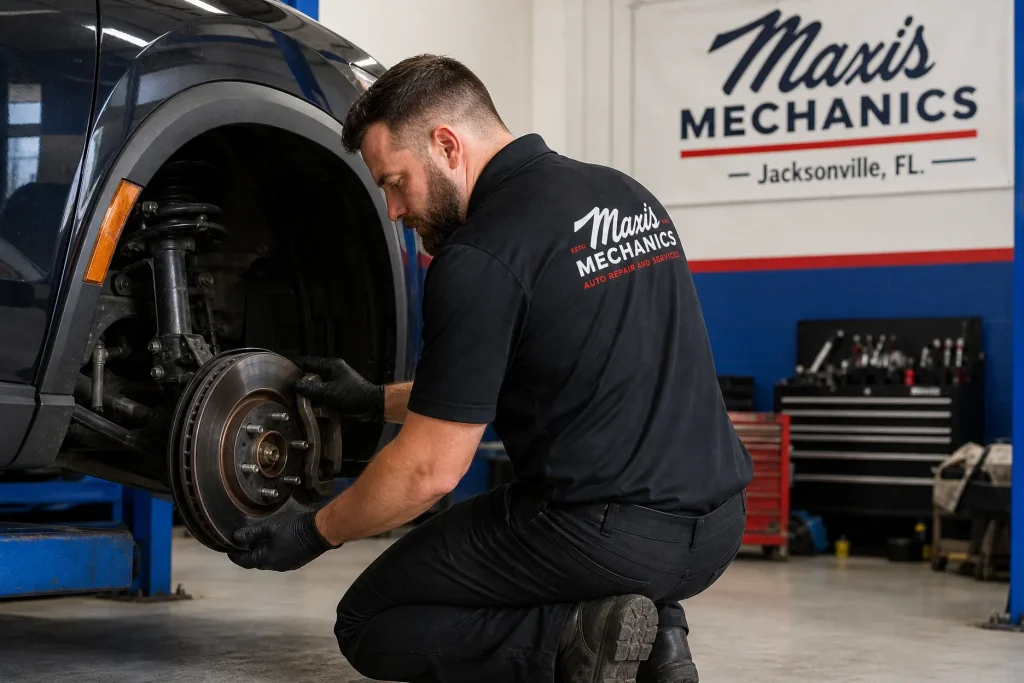
Routine brake inspections every 12,000 miles or annually, using quality brake components, and proper installation techniques prevent most squeal issues. During an inspection, a technician measures pad thickness (pads should be replaced at 3-4 mm remaining to avoid rotor damage), checks rotor thickness and surface condition, inspects caliper hardware and slides for corrosion or binding, and verifies brake fluid condition and level.[6] Catching wear early keeps repair costs low and eliminates noise before it starts.
Choosing the right pad material matters. Ceramic pads produce significantly less dust and noise than semi-metallic pads and perform well in Jacksonville’s heat, though they cost slightly more upfront.[2] Proper installation — including cleaning rotor surfaces, applying brake lubricant to caliper slides and backing plates (never the friction surface), and installing or replacing anti-rattle shims — ensures components fit snugly and dampen vibration. Skipping these steps invites squeal even with new parts.
Driving habits also play a role. Aggressive braking generates excessive heat, which glazes rotors and hardens pad surfaces, increasing noise and reducing friction. Smooth, progressive braking dissipates heat gradually and extends component life.[3] In stop-and-go traffic, leave extra following distance to minimize hard stops.
Schedule service at your nearest Maxi’s Mechanics location in Jacksonville — call (904) 646-4000 or book online at maxiautorepair.com.
Frequently Asked Questions
Can I drive with squealing brakes?
If the squeal is light and occurs only during the first few stops after the car has been parked, it’s usually safe to drive. Persistent squealing that happens every time you brake signals worn pads and should be inspected within one to two weeks. Grinding sounds mean immediate danger — stop driving and have the vehicle towed if necessary.[5]
Do new brakes squeal?
New brakes may squeal for the first 100-200 miles as the pads and rotors bed in and the friction surfaces conform to each other. This is normal. If squealing persists beyond the break-in period, improper installation, missing shims, or incompatible pad material may be the cause — return to the shop for inspection.[2]
Will brake squeal go away on its own?
Squeal caused by surface rust or moisture typically disappears after a few brake applications. Squeal caused by worn pads, glazed rotors, or missing hardware will not resolve itself and will worsen over time. Ignoring persistent squeal leads to rotor damage, higher repair costs, and potential brake failure.[1]
How much does it cost to fix squealing brakes?
Replacing brake pads typically costs $150-$300 per axle at an independent shop in Jacksonville. If the rotors require resurfacing or replacement due to damage from delayed service, expect $300-$600 per axle. Catching squeal early — when only pads need replacement — keeps costs low and prevents more extensive damage.[6]
If your brakes are squealing and you’re unsure whether it’s a minor annoyance or a safety issue, bring your vehicle to Maxi’s Mechanics. Our ASE-certified technicians perform thorough brake inspections at all four Jacksonville locations and explain exactly what your car needs — no upselling, just honest service. Schedule service at your nearest Maxi’s Mechanics location in Jacksonville — call (904) 646-4000 or book online at maxiautorepair.com.
Written by The Team at Maxi’s Mechanics — Maxi’s Mechanics is a veteran-owned, ASE-certified auto repair shop serving Jacksonville, FL since 2003, with four locations: Beach Blvd, Riverside, Hodges, and San Marco. Updated January 2026.
References
- National Highway Traffic Safety Administration. Brake System Maintenance and Inspection Guidelines. https://www.nhtsa.gov/
- Automotive Friction Material Edge Code Implementation Standards, SAE J866. Society of Automotive Engineers. https://www.sae.org/
- Federal Motor Vehicle Safety Standard No. 135 — Light Vehicle Brake Systems. U.S. Department of Transportation. https://www.govinfo.gov/
- ASE Guide to Brake System Diagnosis and Repair. National Institute for Automotive Service Excellence. https://www.ase.com/
- Brake Pad Wear Indicators and Driver Alert Systems. Motorist Assurance Program. https://www.motorist.org/
- AAA Car Care Guide: Brake Service Intervals and Cost Estimates. American Automobile Association. https://www.aaa.com/