Why Is My Car Shaking While Driving?
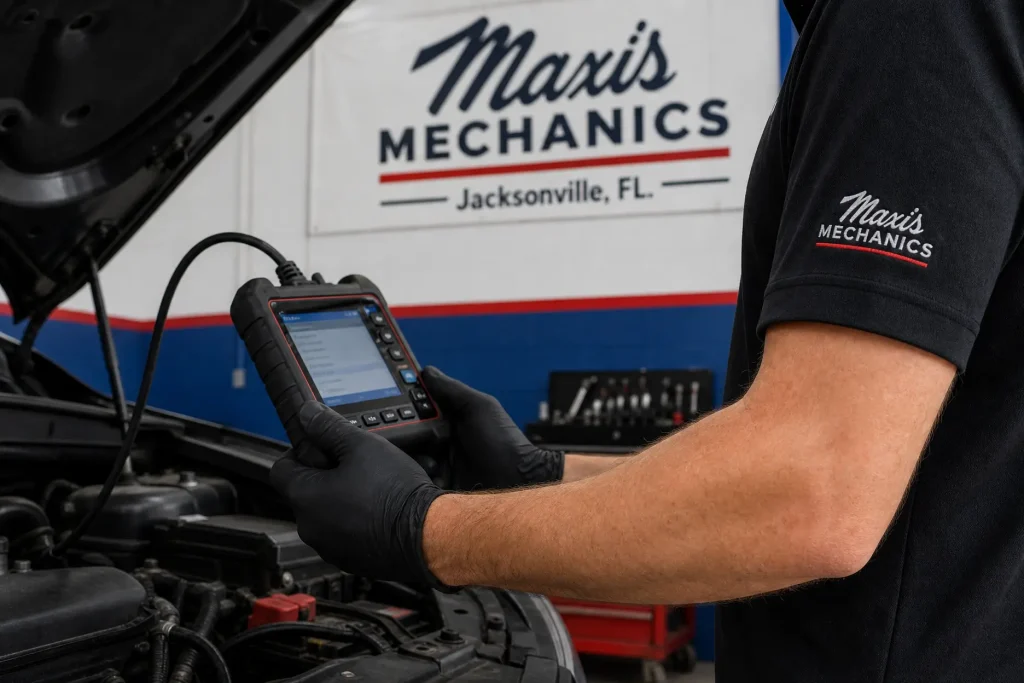
Car shaking while driving typically stems from tire imbalance, wheel alignment issues, worn suspension components, or brake rotor warping. Maxi’s Mechanics in Jacksonville, FL uses computerized diagnostics to pinpoint the exact cause — from minor tire balance adjustments to critical suspension repairs — ensuring safe, smooth operation across all driving conditions.
A shaking car signals an imbalance or wear in the drivetrain, suspension, or braking system. The vibration you feel through the steering wheel, floorboard, or seat indicates which components are affected. Tire-related issues cause consistent shaking that intensifies with speed, while brake problems produce vibration only during deceleration. Suspension wear creates rough handling over bumps and uneven roads.[1]
Written by The Team at Maxi’s Mechanics — Maxi’s Mechanics is a veteran-owned, ASE-certified auto repair shop serving Jacksonville, FL since 2003, with four locations: Beach Blvd, Riverside, Hodges, and San Marco.
What Causes Steering Wheel Vibration at Highway Speeds?
Steering wheel vibration at 50-70 mph usually indicates unbalanced tires or bent wheels. When tire weight distribution is uneven, centrifugal force creates oscillations that transmit through the steering column. A single wheel weight offset by just one ounce produces noticeable shaking at highway speeds.[2]
Bent wheels from pothole impacts or curb strikes create a wobble that worsens with speed. Jacksonville’s road conditions — particularly along Beach Boulevard and I-295 — contribute to wheel damage during Florida’s heavy rain season when potholes are harder to spot. Computerized wheel balancing identifies weight imbalances down to a quarter-ounce, while visual and electronic inspections detect bent rims that require replacement.[3]
Out-of-round tires develop flat spots from prolonged parking or internal belt separation. These defects cause a rhythmic thump-thump vibration that matches wheel rotation speed. Tire pressure monitoring systems don’t detect these structural issues — only physical inspection reveals the damage.
Why Does My Car Shake When I Brake?
Brake shaking occurs when warped rotors create uneven contact with brake pads. Rotors warp from repeated heating and cooling cycles, aggressive braking, or improper wheel torque during installation. The result is a pulsing sensation through the brake pedal and steering wheel during deceleration.[4]
Front rotor warping causes steering wheel vibration, while rear rotor issues produce shaking felt through the vehicle body and seat. Measuring rotor thickness variation with a micrometer identifies warping as small as 0.001 inches — enough to cause noticeable pulsation. Rotors beyond manufacturer specifications require resurfacing or replacement.
Seized brake calipers create constant pad-to-rotor contact on one wheel, generating excessive heat that warps the rotor. This condition also pulls the vehicle to one side during braking. Florida’s humid climate accelerates caliper corrosion, particularly in vehicles driven infrequently or parked near coastal areas of Jacksonville.[5]
Can Bad Alignment Cause Car Shaking?
Misalignment creates uneven tire wear that leads to vibration, but alignment itself doesn’t directly cause shaking. When camber, caster, or toe angles are off-spec, tires scrub sideways as they roll forward. This irregular wear produces cupping or feathering patterns that generate road noise and vibration at all speeds.[6]
Computerized alignment measurements compare your vehicle’s specifications against manufacturer standards. Angles off by even one degree accelerate tire wear and reduce fuel economy by up to 10%. Hitting Jacksonville’s ubiquitous curbs, speed bumps, or railroad crossings knocks alignment out of spec without obvious damage.
Alignment corrections restore proper tire contact with the road surface. However, if tires already show wear patterns from prolonged misalignment, they’ll continue vibrating until replaced. Combining alignment service with tire rotation extends tire life and prevents recurring vibration issues.
What Suspension Problems Cause Vibration While Driving?
Worn suspension components — ball joints, tie rod ends, control arm bushings, and shock absorbers — allow excessive wheel movement that creates vibration and handling instability. Ball joints connect the wheel assembly to the suspension, and when their protective boots crack, contaminants enter and wear the bearing surfaces. This wear permits vertical and horizontal wheel play.[1]
| Component | Failure Symptom | Vibration Condition |
|---|---|---|
| Ball Joints | Clunking over bumps, wheel wobble | Low-speed steering, rough roads |
| Tie Rod Ends | Loose steering, alignment drift | Highway speeds, lane changes |
| Control Arm Bushings | Steering wander, brake dive | Acceleration, braking |
| Shock Absorbers | Bouncing, bottoming out | All speeds, particularly bumps |
| Wheel Bearings | Grinding noise, ABS activation | Increases with speed, turning |
Tie rod ends connect the steering rack to the wheels. When the ball-and-socket joint wears, steering response becomes vague and the vehicle wanders between lanes. A failed tie rod end represents a critical safety hazard — complete separation results in total loss of steering control on the affected wheel.
Control arm bushings isolate road shock and maintain suspension geometry. Cracked or collapsed rubber bushings allow metal-to-metal contact and misalignment of suspension components. Florida’s heat accelerates rubber deterioration, particularly in vehicles exposed to direct sunlight in parking lots.
Worn shock absorbers fail to dampen spring oscillation, causing the vehicle to bounce excessively over bumps. This bouncing creates a floating sensation and reduces tire contact with the road. The bounce test — pushing down on each corner and counting rebounds — provides a quick field assessment, but only dynamometer testing measures true damping performance.[7]
Schedule service at your nearest Maxi’s Mechanics location in Jacksonville — call (904) 646-4000 or book online at maxiautorepair.com.
How Do Wheel Bearings Cause Car Vibration?
Failing wheel bearings produce grinding noise and vibration that intensifies during turns and at higher speeds. Wheel bearings allow the hub assembly to rotate smoothly around the axle. When bearing races pit or ball bearings lose lubrication, friction increases and the assembly develops excessive play.[8]
A bad wheel bearing creates a humming or growling noise that changes pitch with vehicle speed. During turns, load shifts to the outer wheels — if the bearing on that side is worn, the noise and vibration intensify. Complete bearing failure causes the wheel to seize or separate from the hub, resulting in catastrophic loss of control.
Bearing inspection involves lifting the vehicle and checking for wheel play in the vertical and horizontal planes. Electronic wheel speed sensors detect bearing wear through ABS system data — erratic speed readings from one wheel indicate bearing damage. Sealed bearing assemblies common in modern vehicles require complete hub replacement rather than bearing repacking.
Can Engine or Transmission Mounts Cause Shaking?
Worn engine and transmission mounts allow excessive drivetrain movement that creates vibration during acceleration, deceleration, and idle. These rubber-and-metal assemblies isolate engine vibration from the chassis. When the rubber deteriorates, the engine shifts under torque and contacts the subframe or other components.[3]
Engine mount failure produces a distinct clunk when shifting from park to drive or reverse. At idle in gear, worn mounts allow enough engine movement to create a vibration felt through the steering wheel and floorboard. This vibration disappears when shifted to neutral because engine torque load releases.
Transmission mounts secure the transmission case to the chassis crossmember. A collapsed transmission mount causes the driveshaft to operate at an incorrect angle, generating vibration through the drivetrain. Front-wheel-drive vehicles with transverse engines use multiple mounts — a single failed mount dramatically increases stress on the remaining mounts, accelerating their wear.
Frequently Asked Questions
Is it safe to drive a car that shakes?
Driving a shaking car is unsafe because the vibration indicates mechanical failure that will worsen. Tire, wheel bearing, or suspension failures cause sudden loss of control. Have the vehicle diagnosed immediately to identify the cause and severity.
Why does my car shake only at certain speeds?
Speed-specific shaking indicates resonance frequency where the vibration source matches the vehicle’s natural oscillation. Tire balance issues appear at 50-70 mph, while driveshaft imbalance causes vibration at 40-50 mph. The speed range helps technicians identify the component.
Can low tire pressure cause car shaking?
Low tire pressure doesn’t directly cause shaking but exacerbates existing balance or alignment issues. Underinflated tires flex excessively, creating uneven contact patches that produce vibration. Maintain manufacturer-recommended pressure listed on the driver’s door jamb.
How much does it cost to fix a shaking car in Jacksonville?
Repair costs range from $50 for tire balancing to $1,200 for suspension component replacement. Wheel alignment costs $75-$150, brake rotor service runs $300-$600, and wheel bearing replacement costs $250-$500 per wheel depending on vehicle make and model.
Will new tires stop my car from shaking?
New tires eliminate shaking only if worn or damaged tires caused the problem. If the vibration stems from alignment, suspension, or brake issues, new tires won’t resolve it. Proper diagnosis identifies whether tires are the cause or if underlying mechanical problems exist.
Car shaking while driving requires immediate professional diagnosis to identify the root cause and prevent safety hazards. Whether the vibration comes from tires, brakes, suspension, or drivetrain components, addressing it promptly prevents accelerated wear and potential failure. Schedule service at your nearest Maxi’s Mechanics location in Jacksonville — call (904) 646-4000 or book online at maxiautorepair.com.
Written by The Team at Maxi’s Mechanics — Maxi’s Mechanics is a veteran-owned, ASE-certified auto repair shop serving Jacksonville, FL since 2003, with four locations: Beach Blvd, Riverside, Hodges, and San Marco. Updated January 2026.
References
- National Highway Traffic Safety Administration. Vehicle Suspension Systems. https://www.nhtsa.gov/
- Tire Industry Association. Tire Balance and Vibration Diagnosis Standards. https://www.tireindustry.org/
- Automotive Service Association. Drivetrain Vibration Analysis Best Practices. https://www.asashop.org/
- Brake Manufacturers Council. Rotor Thickness Variation and Brake Pulsation. https://www.mema.org/
- Society of Automotive Engineers. Brake System Maintenance in High-Humidity Climates (SAE J2928). https://www.sae.org/
- Hunter Engineering Company. Wheel Alignment and Tire Wear Patterns Technical Manual. https://www.hunter.com/
- Automotive Lift Institute. Vehicle Suspension Inspection Procedures. https://www.autolift.org/
- National Institute for Automotive Service Excellence. Wheel Bearing Diagnosis and Replacement (ASE A4). https://www.ase.com/