How Long Can You Drive With an Overheating Engine?
You should not drive more than 30 seconds to 1 minute with an overheating engine — prolonged operation at excessive temperatures causes irreversible damage to cylinder heads, gaskets, and the engine block. Maxi’s Mechanics in Jacksonville, FL provides emergency overheating diagnostics and engine repair across four ASE-certified locations to prevent costly failures.
You should pull over immediately when your temperature gauge enters the red zone or the warning light activates. Driving an overheating engine for even a few minutes can warp cylinder heads, blow head gaskets, crack the engine block, or seize pistons — repairs that often exceed the vehicle’s value. The safe window is measured in seconds, not miles, and depends on how far above normal operating temperature your engine has climbed.
Written by The Team at Maxi’s Mechanics — Maxi’s Mechanics is a veteran-owned, ASE-certified auto repair shop serving Jacksonville, FL since 2003, with four locations: Beach Blvd, Riverside, Hodges, and San Marco.
What Happens Inside an Engine When It Overheats?
Modern engines operate within a narrow temperature range of 195–220°F; exceeding 240°F begins thermal breakdown of lubricants and metal expansion beyond design tolerances.[1] The aluminum alloy used in most cylinder heads expands faster than cast iron engine blocks, causing warping at the mating surfaces. Head gaskets — multi-layer steel or composite seals between the block and heads — fail when this warping creates pressure differentials that breach combustion chambers.[2]
Coolant loss accelerates the damage cycle. A breached head gasket allows coolant into cylinders, where it vaporizes and exits through the exhaust as white smoke. Simultaneously, combustion gases enter the cooling system, creating air pockets that prevent coolant circulation. Engine oil loses viscosity above 250°F, turning from a protective film into a thin liquid that cannot prevent metal-to-metal contact between pistons and cylinder walls.[3] In Jacksonville’s summer heat, ambient temperatures above 95°F reduce cooling system efficiency by 15–20%, shortening the failure timeline.
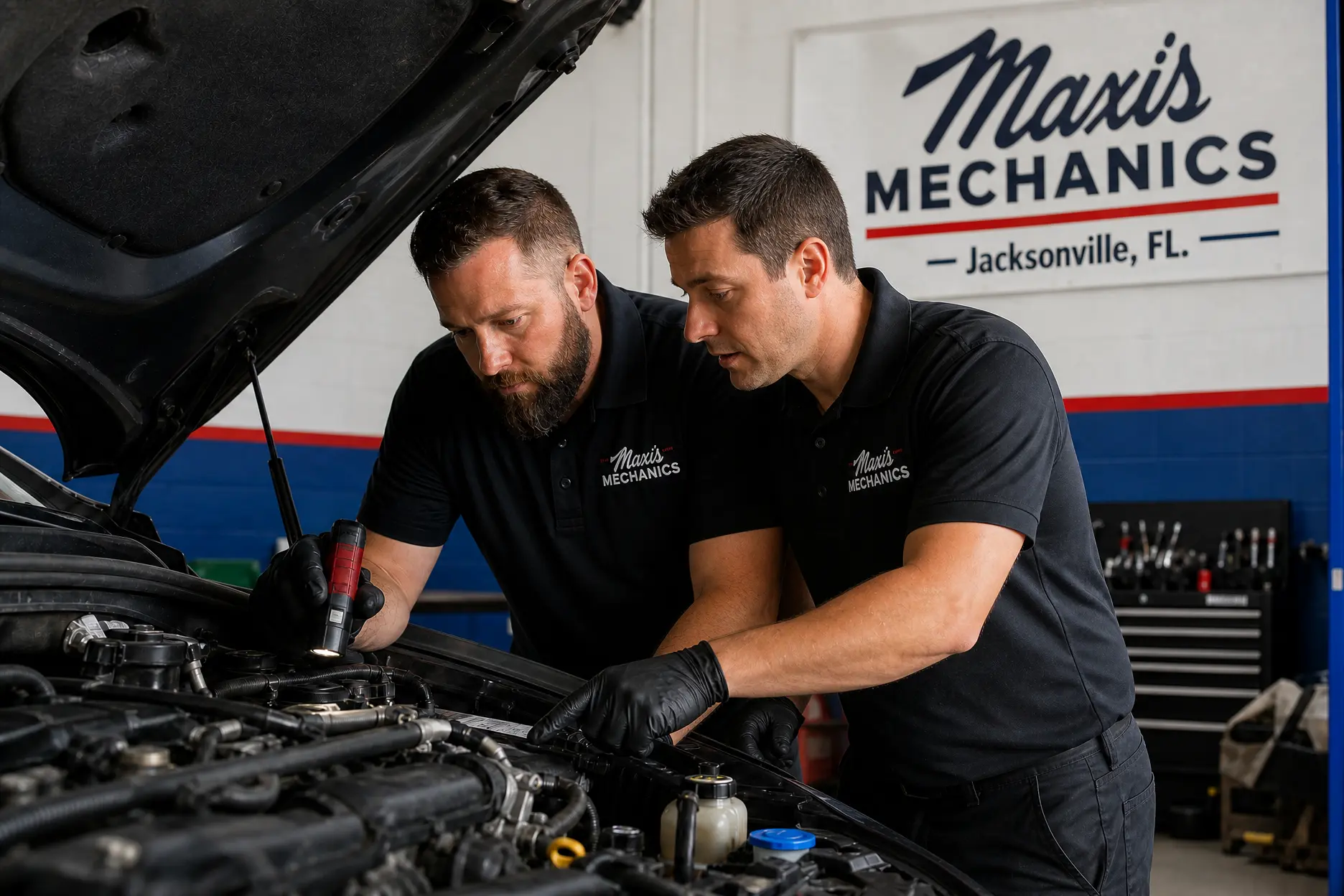
How Long Before Permanent Damage Occurs?
Catastrophic engine damage begins within 60 seconds of sustained operation above 260°F.[4] The progression follows a predictable sequence: oil breakdown occurs first (30–60 seconds), followed by gasket failure (1–3 minutes), then cylinder head warping (3–5 minutes), and finally piston seizure or block cracking (5–10 minutes). These timeframes assume the engine entered the red zone from normal operating temperature; if overheating developed gradually due to a failing water pump or clogged radiator, damage may already be underway when the gauge climbs.
The speed of damage depends on load conditions. Highway driving at 70 mph generates more combustion heat than city speeds, accelerating thermal stress. Towing or climbing grades in Florida’s summer humidity can push a marginal cooling system into failure within minutes. Stop-and-go traffic removes airflow through the radiator, relying entirely on the electric cooling fan — if that fan motor fails, temperatures spike rapidly at idle.[5]
What Are the Most Common Causes of Engine Overheating?
Coolant system failures account for 80% of overheating incidents, with leaking hoses, failed thermostats, and low coolant levels leading the list.[6] The thermostat — a spring-loaded valve that opens at a preset temperature (typically 195°F) — can stick closed, blocking coolant flow to the radiator. A failing water pump loses impeller vanes to corrosion, reducing circulation pressure. Radiator cores clog internally with sediment when coolant is not flushed every 30,000 miles, as recommended by most manufacturers.
Air conditioning systems in Jacksonville vehicles work harder than in moderate climates, forcing the condenser (mounted ahead of the radiator) to reject significant heat. When the condenser blocks airflow due to debris accumulation — common with Florida’s pollen, bugs, and road grime — radiator efficiency drops 25–30%. Electric cooling fans fail due to burned-out motors or corroded wiring connections, eliminating forced airflow at idle. Collapsed radiator hoses, split heater hoses, and leaking freeze plugs all reduce coolant volume below the system’s heat-rejection capacity.
What Should You Do Immediately When Your Car Overheats?
Turn off the air conditioning, turn the heater to maximum, and pull over safely within 30 seconds of the temperature warning. The heater core acts as a secondary radiator; running the blower on high and heat on maximum transfers engine heat into the cabin, buying critical seconds to exit traffic. Do not shut off the engine immediately if you are on a highway — modern power steering and brakes require engine vacuum and hydraulic pressure, so maintain operation only long enough to reach a safe shoulder position.
Once stopped, shift to neutral or park and let the engine idle for 10–15 seconds before shutting down. Abrupt shutdown can trap heat in localized areas of the block, increasing warping risk. Never open the radiator cap or coolant reservoir while the engine is hot — pressurized coolant at 260°F will flash to steam instantly, causing severe burns.[1] Wait at least 30 minutes before checking coolant levels. If you must add coolant, use a 50/50 mix of ethylene glycol antifreeze and distilled water; tap water introduces minerals that accelerate corrosion.
Can You Drive Short Distances to Reach a Repair Shop?
Only if the temperature gauge returns to normal after idling for 10 minutes and coolant level is adequate. If the gauge climbs again within 2 minutes of driving, the underlying failure has not resolved, and further operation will cause damage. Monitor the gauge constantly; if it approaches the red zone, pull over immediately. Some drivers attempt “drive-and-coast” strategies, shutting off the engine and coasting to cool between brief running periods, but this risks losing power steering and brakes in traffic.
How Much Does Overheating Damage Cost to Repair?
Head gasket replacement ranges from $1,200 to $2,500 depending on engine configuration; warped cylinder heads add $800 to $1,500 for machining or replacement.[7] V6 and V8 engines cost more due to dual head gaskets and increased labor hours. If overheating progresses to piston seizure or block cracking, repair costs often exceed $4,000 — at that point, engine replacement becomes the economical choice for vehicles under 150,000 miles.
| Damage Type | Typical Repair Cost | Labor Hours |
|---|---|---|
| Thermostat replacement | $150–$300 | 1–2 |
| Water pump replacement | $400–$700 | 3–4 |
| Radiator replacement | $500–$900 | 2–3 |
| Head gasket (4-cylinder) | $1,200–$1,800 | 8–10 |
| Head gasket (V6/V8) | $2,000–$3,000 | 12–16 |
| Cylinder head machining | $300–$500 per head | Included in head gasket labor |
Preventive maintenance costs a fraction of overheating repairs. Coolant flushes every 30,000 miles cost $100–$150 and prevent 70% of cooling system failures.[8] Annual hose and belt inspections catch cracks and swelling before failures occur. In Jacksonville’s heat and humidity, cooling system stress exceeds that of northern climates by 20–30%, making regular inspections even more critical.
Schedule service at your nearest Maxi’s Mechanics location in Jacksonville — call (904) 646-4000 or book online at maxiautorepair.com.
How Can You Prevent Engine Overheating in Jacksonville’s Climate?
Maintain coolant at the proper 50/50 mixture ratio and replace it every 30,000 miles or 3 years, whichever comes first.[8] Jacksonville’s heat accelerates coolant additive depletion; corrosion inhibitors lose effectiveness after 36 months, allowing rust and scale buildup that clogs radiator tubes. Check coolant level monthly when the engine is cold — chronic low levels indicate a leak that requires immediate diagnosis.
Inspect radiator airflow monthly, especially March through October when pollen and bug accumulation peak. Rinse the radiator and condenser from the engine side using low-pressure water, moving from top to bottom to avoid bending cooling fins. Replace serpentine belts every 60,000 miles; a slipping belt reduces water pump speed by 10–15%, cutting circulation capacity. Test the cooling fan by running the air conditioning at idle — the fan should engage within 30 seconds and produce noticeable airflow through the grille.
Frequently Asked Questions
Can I use water instead of coolant in an emergency?
You can use plain water temporarily to reach a repair shop, but do not operate the vehicle long-term without proper antifreeze. Water alone boils at 212°F (versus 265°F for 50/50 coolant mix) and provides no corrosion protection, causing rust that clogs the cooling system within weeks.[1]
Why does my car overheat only in traffic, not on the highway?
Highway speeds force ram air through the radiator, providing cooling even if the electric fan fails. In stop-and-go traffic, the fan must provide all airflow; if the fan motor, relay, or temperature sensor malfunctions, temperatures climb rapidly at idle. This pattern indicates a failed cooling fan or clogged radiator reducing low-speed heat rejection.[5]
Will overheating once cause permanent engine damage?
A single brief overheating incident (under 60 seconds in the red zone) typically causes no permanent damage if you stop immediately. However, even one episode warps gaskets slightly, making future failures more likely. Always have the cooling system pressure-tested after any overheating event to identify leaks or weak points before they strand you.[4]
How hot is too hot for an engine temperature gauge?
Normal operating temperature is 195–220°F, typically shown as the center position on the gauge. Anything above three-quarters (approximately 240°F) requires immediate shutdown. Modern engines have tighter tolerances than older designs and suffer damage faster when overheated — aluminum components warp at lower temperatures than cast iron.[2]
Can low oil cause overheating?
Severely low oil (more than 2 quarts below capacity) reduces heat transfer from pistons and bearings, contributing to overheating. However, coolant system failures cause 80% of overheating incidents; oil-related overheating usually triggers the oil pressure warning light before the temperature gauge climbs. If both lights activate simultaneously, stop immediately to prevent engine seizure.[3]
An overheating engine is an emergency that requires immediate action — the difference between a $200 repair and a $3,000 engine replacement is often measured in seconds. If your temperature gauge climbs or your warning light activates, pull over safely, shut down the engine, and call for professional diagnostics. Attempting to “make it home” or “just get to work” guarantees catastrophic damage that leaves you stranded and facing major repair bills.
Schedule service at your nearest Maxi’s Mechanics location in Jacksonville — call (904) 646-4000 or book online at maxiautorepair.com.
Written by The Team at Maxi’s Mechanics — Maxi’s Mechanics is a veteran-owned, ASE-certified auto repair shop serving Jacksonville, FL since 2003, with four locations: Beach Blvd, Riverside, Hodges, and San Marco. Updated January 2026.
References
- Engineering Toolbox. Engine Coolant Properties and Heat Transfer. https://www.engineeringtoolbox.com/ethylene-glycol-d_146.html
- SAE International. Cylinder Head Gasket Technology and Performance Standards J1830. https://www.sae.org/standards/content/j1830/
- Machinery Lubrication. Effects of Temperature on Lubricant Performance. https://www.machinerylubrication.com/Read/662/oil-temperature
- Automotive Engineering International. Thermal Management in Modern Engines. https://www.sae.org/news/magazines/automotive-engineering
- ASE (National Institute for Automotive Service Excellence). Cooling System Diagnosis and Repair Guide. https://www.ase.com/
- Car Care Council. Cooling System Maintenance Statistics and Best Practices. https://www.carcare.org/
- RepairPal. Average Head Gasket Replacement Costs by Vehicle Type. https://repairpal.com/head-gasket-replacement-cost
- AAA Automotive Research Center. Preventive Maintenance Cost-Benefit Analysis. https://www.aaa.com/autorepair/