Can You Drive With a Bad Water Pump?
You should not drive with a bad water pump beyond the shortest distance necessary to reach a repair facility. A failing water pump cannot circulate coolant effectively, causing engine temperatures to spike within 5-10 minutes of operation, which can warp cylinder heads, crack engine blocks, and lead to repair costs exceeding $3,000. Maxi’s Mechanics in Jacksonville, FL provides emergency water pump diagnostics and replacement at four convenient locations across the city.
No, you cannot safely drive with a bad water pump for any meaningful distance. The water pump is the heart of your engine’s cooling system, and when it fails, coolant stops circulating through the engine block and radiator. Without active coolant flow, combustion chamber temperatures can exceed 250°F within minutes, causing immediate and often irreversible damage to gaskets, seals, and metal components.[1] While your vehicle may continue running briefly after water pump failure, every additional mile increases the risk of catastrophic engine damage that transforms a $400-$800 pump replacement into a $4,000+ engine rebuild.
Written by The Team at Maxi’s Mechanics — Maxi’s Mechanics is a veteran-owned, ASE-certified auto repair shop serving Jacksonville, FL since 2003, with four locations: Beach Blvd, Riverside, Hodges, and San Marco.
What Happens When You Drive With a Bad Water Pump?
Driving with a failing water pump causes rapid coolant circulation failure, leading to engine overheating within 5-15 minutes depending on ambient temperature and load conditions. The water pump uses an impeller driven by the serpentine belt to push coolant from the radiator through the engine block, absorbing combustion heat before returning hot coolant to the radiator for cooling.[2] When the pump fails — whether from bearing seizure, impeller erosion, or seal rupture — this circulation stops, and coolant becomes stagnant in the system.
Modern engines generate combustion temperatures exceeding 2,000°F in the cylinders. Under normal operation, coolant flowing at 10-15 gallons per minute absorbs this heat and maintains operating temperatures between 195°F and 220°F.[3] Without circulation, heat transfer stops, and the coolant surrounding the cylinders begins to boil. Steam pockets form in the cooling passages, further reducing heat dissipation. The temperature gauge climbs rapidly, often reaching the red zone within 10 minutes of highway driving or 15 minutes of city traffic in Jacksonville’s summer heat.
Once the engine exceeds its design temperature threshold, damage cascades quickly. Aluminum cylinder heads expand at different rates than cast iron blocks, warping mating surfaces and compromising head gasket integrity. Overheated oil loses viscosity, allowing metal-to-metal contact in bearings and piston rings. In extreme cases, coolant passages crack, pistons seize, and connecting rods fail — all damage that cannot be repaired without complete engine disassembly or replacement.
What Are the Symptoms of a Failing Water Pump?
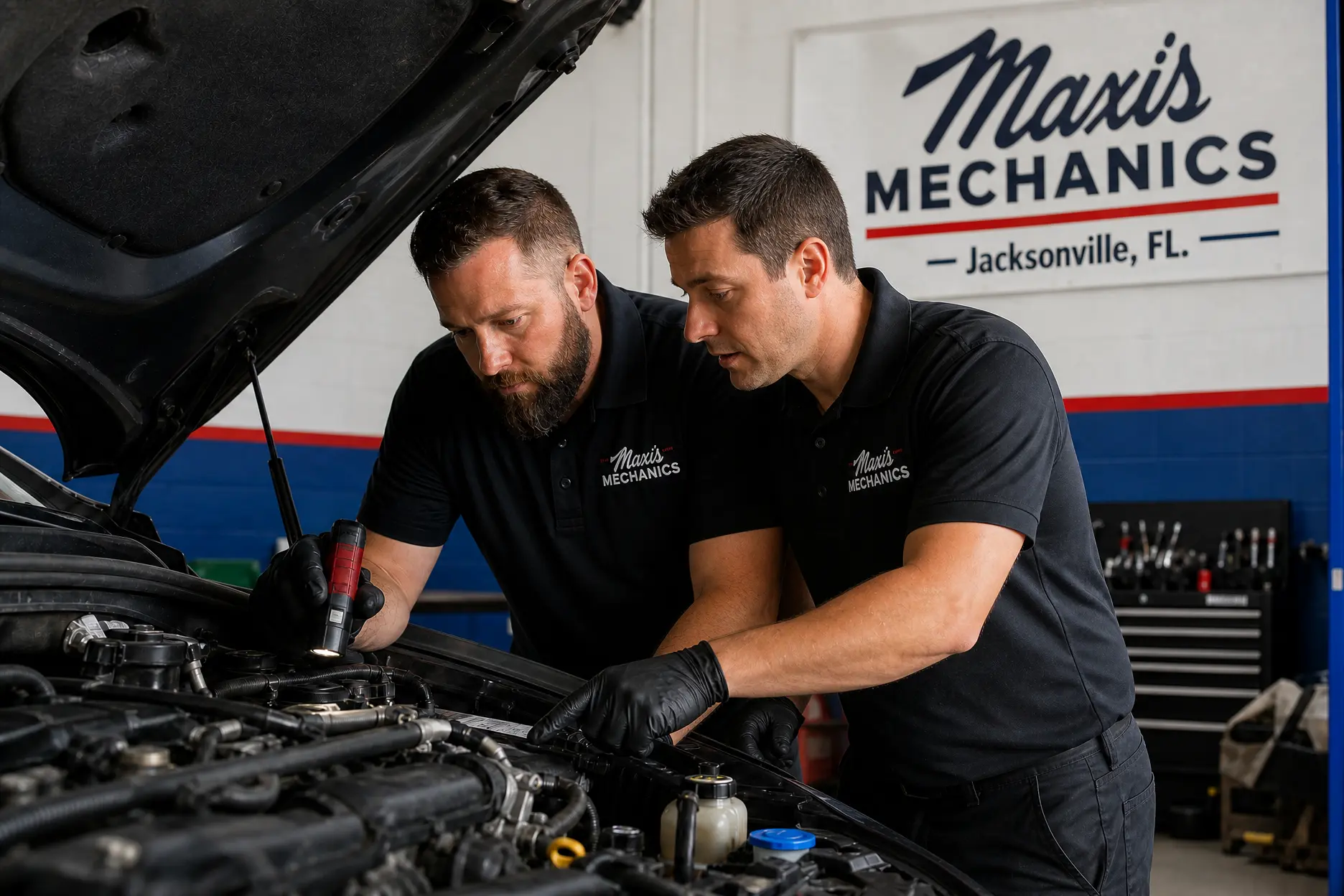
The most common bad water pump symptoms include coolant leaks near the front of the engine, whining or grinding noises from the pump bearing, steam from the hood, and rapid temperature gauge fluctuations. Early detection is critical because water pumps rarely fail instantaneously — they degrade over weeks or months, providing warning signs before complete failure.[4]
Visible Coolant Leaks
Water pumps seal the pressurized cooling system using a mechanical seal behind the pulley. When this seal wears, coolant seeps from the weep hole — a small drain designed to prevent coolant from contaminating the bearing. You’ll notice green, orange, or pink fluid pooling under the front-center of your vehicle after it’s been parked, or dried residue and staining on the pump housing. Leaks that begin as a few drops per day will accelerate as seal deterioration continues.
Unusual Noises From the Engine Bay
A failing water pump bearing produces a distinctive whining, squealing, or grinding sound that increases with engine RPM. The bearing supports the pump shaft that drives the impeller, and when it loses lubrication or develops play, metal components contact each other under the load of the serpentine belt. This noise is most noticeable during cold starts and becomes continuous as bearing damage progresses. In Jacksonville’s humid climate, bearing corrosion accelerates wear, making early diagnosis essential.
Overheating Engine and Temperature Spikes
As pump impeller blades erode or the shaft develops wobble, coolant flow decreases even though the pump appears to operate. You’ll notice the temperature gauge climbing higher than normal during highway driving or when idling with the air conditioning running. Some vehicles experience temperature fluctuations — the gauge rises, then drops when the thermostat opens, then rises again — indicating inadequate coolant circulation. These symptoms worsen under load and in hot weather, conditions common year-round in Northeast Florida.
How Far Can You Drive With a Bad Water Pump Before Damage Occurs?
You can typically drive 5-10 miles with a completely failed water pump before causing permanent engine damage, but this distance varies dramatically based on ambient temperature, driving speed, and engine load. The critical factor is time above the safe operating temperature, not distance traveled. An engine idling in Jacksonville summer traffic may overheat in 8-10 minutes, while highway driving at 70 mph with full air conditioning load can trigger overheating in as little as 5 minutes.[5]
If your water pump fails while driving, you have a narrow window to respond. The moment your temperature gauge enters the red zone or the temperature warning light illuminates, you should immediately reduce engine load by turning off the air conditioning, shifting to neutral on downhill grades, and reducing speed. If safe to do so, pull over within 1-2 minutes to prevent damage. Continuing to drive — even short distances — can warp cylinder heads, blow head gaskets, or crack the engine block, transforming a $600 repair into a $4,000+ engine replacement.
The “limp home” strategy of driving short distances with frequent cool-down stops is risky and often fails. Each heat cycle causes cumulative damage to gaskets and seals. Metal components expand and contract repeatedly, accelerating fatigue failures. If your water pump shows signs of failure but hasn’t completely seized, schedule immediate repair rather than gambling on “just one more trip.” At Maxi’s Mechanics, we provide same-day diagnostics at our four Jacksonville locations to prevent emergency situations from becoming catastrophic failures.
| Driving Condition | Time to Overheat | Estimated Distance | Damage Risk |
|---|---|---|---|
| Highway (65-70 mph) | 5-8 minutes | 5-9 miles | Very High |
| City traffic (25-35 mph) | 10-12 minutes | 4-7 miles | High |
| Idle with A/C | 8-10 minutes | 0 miles | High |
| Idle without A/C | 15-20 minutes | 0 miles | Moderate |
What Should You Do If Your Water Pump Fails While Driving?
If you notice overheating symptoms while driving, immediately turn off the air conditioning, turn the heater to maximum hot, pull over safely within 1-2 minutes, and shut off the engine. The heater core acts as a secondary radiator, and running the heater at full blast can extract enough heat from the coolant to buy you precious seconds before critical damage occurs.[6] Do not attempt to continue driving once the temperature warning light illuminates or the gauge enters the red zone — each additional minute of operation exponentially increases repair costs.
After pulling over, do not immediately open the radiator cap or coolant reservoir. Overheated coolant remains under pressure and can erupt violently, causing severe burns. Wait at least 30 minutes for the engine to cool before checking coolant levels. If you must add coolant, use only the manufacturer-specified type — mixing coolant formulations can create sludge that further blocks circulation. Once the engine cools, you may attempt to drive to the nearest repair facility, but monitor the temperature gauge continuously and be prepared to pull over again if it begins to rise.
The safest approach is to call for a tow rather than risk driving on a failed water pump. Towing costs $75-$150 in the Jacksonville area, while a warped cylinder head adds $1,500-$2,500 to your repair bill. If you’re near one of Maxi’s Mechanics’ four Jacksonville locations, call ahead at (904) 646-4000 so we can prepare for emergency service and potentially send a technician to assess whether a short drive is safe.
Schedule service at your nearest Maxi’s Mechanics location in Jacksonville — call (904) 646-4000 or book online at maxiautorepair.com.
How Much Does Water Pump Replacement Cost?
Water pump replacement typically costs $400-$800 for most vehicles, including parts and labor, though luxury and performance vehicles can exceed $1,200 due to complex engine access requirements. The pump itself ranges from $50-$200 for aftermarket units to $150-$400 for OEM parts, while labor accounts for $250-$600 depending on engine configuration.[7] Front-wheel-drive V6 engines and vehicles requiring timing belt removal for pump access fall at the higher end of the cost spectrum.
ASE-certified technicians recommend replacing the thermostat, serpentine belt, and coolant hoses during water pump service because these components have similar service lives and are already accessible during the repair. This comprehensive approach adds $100-$200 to the total but prevents return visits for related failures. If your vehicle uses a timing belt to drive the water pump, replacing the pump during scheduled timing belt service (typically 60,000-100,000 miles) saves significant labor costs because both procedures require the same disassembly steps.
Delaying water pump replacement after symptoms appear inevitably increases costs. A pump that begins leaking will accelerate wear on the serpentine belt tensioner and alternator bearings as coolant contacts these components. A pump that overheats the engine once may warp cylinder heads imperceptibly, causing head gasket failure months later. In Jacksonville’s climate, where summer temperatures regularly exceed 95°F and engines work harder to maintain cabin cooling, water pump failures progress faster than in moderate climates. Addressing symptoms early keeps repairs predictable and affordable.
How Long Do Water Pumps Last?
Most water pumps last 60,000-100,000 miles under normal operating conditions, though service life varies by manufacturer, coolant maintenance, and driving environment. Vehicles driven primarily on highways with regular coolant flushes often exceed 100,000 miles on the original pump, while city-driven vehicles in hot climates like Jacksonville may require replacement at 60,000-70,000 miles.[8] Timing-belt-driven pumps typically follow the belt replacement interval (60,000-90,000 miles), while serpentine-belt-driven pumps may last longer because they operate at lower speeds and experience less stress.
Coolant condition directly affects pump longevity. Modern coolants contain corrosion inhibitors that protect pump seals and bearings, but these additives degrade over time. Manufacturers typically specify coolant replacement every 30,000-50,000 miles or 3-5 years. Using the wrong coolant type or mixing formulations accelerates seal deterioration and bearing corrosion. Jacksonville’s hard water compounds this issue if tap water is added to the cooling system, leaving mineral deposits that erode impeller blades and restrict coolant passages.
Frequently Asked Questions
Can a bad water pump cause the check engine light to come on?
A failing water pump does not directly trigger the check engine light because the pump has no electronic sensors. However, the engine overheating caused by pump failure will illuminate the check engine light once coolant temperature exceeds safe thresholds, typically storing codes P0217 (engine overheating) or P0118 (coolant temperature sensor circuit high). The temperature warning light or gauge provides earlier indication of pump problems.
Will a bad water pump make noise when the engine is off?
No, a bad water pump only makes noise when the engine is running and the serpentine belt is turning the pump pulley. The characteristic whining or grinding sound from a failing bearing requires the pump shaft to be rotating under load. If you hear noises with the engine off, suspect other components like the starter motor, alternator bearings, or belt tensioner pulleys.
Can you replace a water pump yourself?
Experienced DIY mechanics can replace water pumps on simple engine configurations with basic tools, but the job requires draining coolant, removing the serpentine belt, and properly torquing bolts to manufacturer specifications. Timing-belt-driven pumps require specialized tools and timing procedures that most home mechanics should not attempt. Improper installation can cause coolant leaks, belt misalignment, or timing errors that damage the engine, making professional installation advisable for most vehicle owners.
How do you know if your water pump or thermostat is bad?
A bad water pump typically causes coolant leaks, bearing noise, and progressive overheating that worsens under load, while a stuck thermostat causes sudden overheating or failure to reach operating temperature. Thermostats fail in closed or open positions — closed causes immediate overheating even at idle, while open prevents the engine from warming up. A technician can diagnose the specific component using temperature measurements at different points in the cooling system.
What causes a water pump to fail prematurely?
Premature water pump failure most commonly results from contaminated coolant, improper belt tension, and cavitation damage. Old or incorrect coolant erodes seals and bearings, while loose belts allow the pulley to wobble and damage the bearing. Overtight belts create excessive side load that accelerates bearing wear. Cavitation — bubble formation from low coolant levels or air in the system — erodes impeller blades, reducing pump efficiency years before normal wear would cause failure.
If you notice any signs of water pump failure — leaks, noises, or overheating — don’t risk catastrophic engine damage by continuing to drive. Schedule service at your nearest Maxi’s Mechanics location in Jacksonville — call (904) 646-4000 or book online at maxiautorepair.com.
Written by The Team at Maxi’s Mechanics — Maxi’s Mechanics is a veteran-owned, ASE-certified auto repair shop serving Jacksonville, FL since 2003, with four locations: Beach Blvd, Riverside, Hodges, and San Marco. Updated January 2026.
References
- U.S. Department of Energy. Vehicle Technologies Office: Cooling System Fundamentals. https://www.energy.gov/eere/vehicles/cooling-systems
- SAE International. J1269: Rolling Element Bearings Used in Automotive Applications. https://www.sae.org/standards/content/j1269/
- National Institute for Automotive Service Excellence. ASE A1 Engine Repair Study Guide, Cooling System Section. https://www.ase.com/Tests/ASE-Certification-Tests/A1-Engine-Repair.aspx
- Gates Corporation. Water Pump Technical Manual: Failure Modes and Diagnostics. https://www.gates.com/us/en/knowledge-center/water-pumps.html
- Engine Rebuilders Association. Overheating Damage Progression Study. https://www.enginerebuilders.org/
- National Highway Traffic Safety Administration. Vehicle Owner Emergency Procedures. https://www.nhtsa.gov/vehicle-safety
- Automotive Aftermarket Suppliers Association. Water Pump Replacement Labor Time Guide. https://www.aftermarketsuppliers.org/
- Society of Automotive Engineers. J2267: Coolant System Service Life Standards. https://www.sae.org/standards/content/j2267/