What Does a Burning Smell From Your Engine Mean?
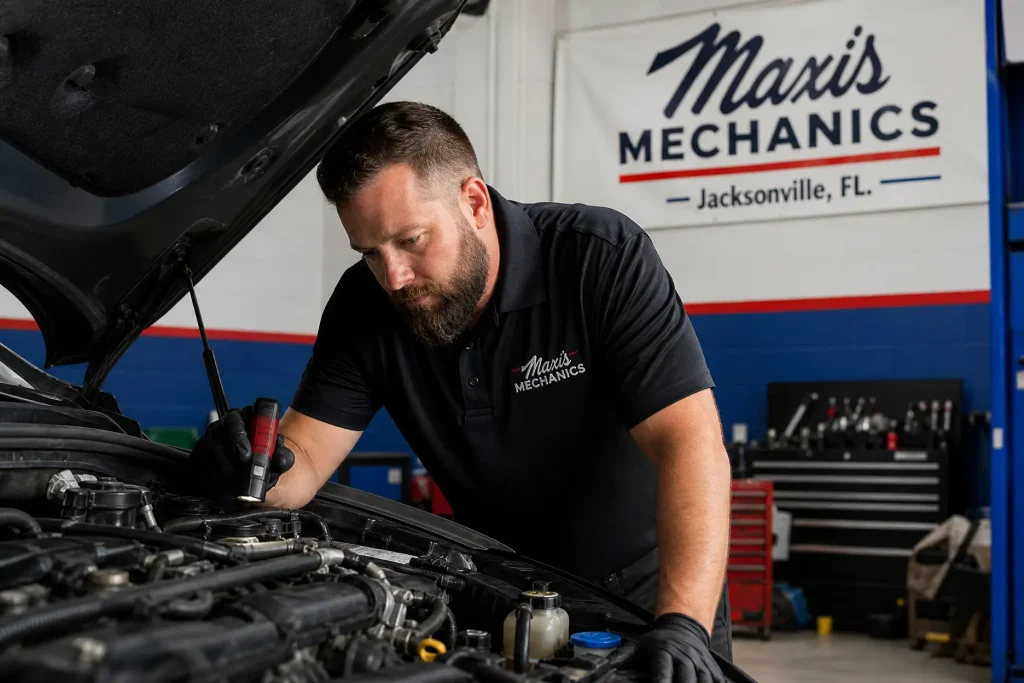
A burning smell from your engine typically indicates overheating components, leaking fluids contacting hot surfaces, or worn mechanical parts generating excessive friction. Maxi’s Mechanics in Jacksonville, FL diagnoses burning odors through systematic inspection of belts, hoses, fluid leaks, and engine compartment temperatures to identify the root cause and prevent serious damage.
A burning smell from your engine usually signals one of five conditions: oil leaking onto hot exhaust components, coolant boiling over, rubber belts or hoses deteriorating against pulleys, electrical wiring insulation melting, or clutch material overheating. The specific odor — burnt oil, sweet coolant, acrid rubber, or sharp electrical — points to different systems, and recognizing these distinctions helps you assess urgency and communicate symptoms to your technician.
Written by The Team at Maxi’s Mechanics — Maxi’s Mechanics is a veteran-owned, ASE-certified auto repair shop serving Jacksonville, FL since 2003, with four locations: Beach Blvd, Riverside, Hodges, and San Marco.
What Causes a Burning Oil Smell From the Engine?
A burning oil smell occurs when engine oil leaks onto hot exhaust manifolds, catalytic converters, or cylinder heads, where temperatures exceed 400°F and vaporize the oil. Common leak sources include valve cover gaskets, oil pan gaskets, camshaft seals, and crankshaft seals that degrade over time due to heat cycling and age.[1] In Florida’s heat and humidity, gasket materials deteriorate faster than in cooler climates, making regular inspections critical for Jacksonville drivers.
Blue-gray smoke accompanying the burning oil smell indicates oil entering the combustion chamber through worn piston rings or valve stem seals.[2] This condition increases oil consumption and can damage catalytic converters when oil residue accumulates on catalyst substrates. Check your dipstick weekly — oil levels dropping more than one quart between changes warrant immediate diagnostic service. ASE-certified technicians use UV dye tracing and pressure testing to pinpoint leak locations without disassembly.

Why Does My Car Smell Like Burning Rubber?
Burning rubber smells stem from serpentine belts slipping on pulleys, radiator hoses contacting moving engine components, or tires rubbing against wheel wells during turns. Serpentine belt slip happens when belt tensioners weaken, pulleys seize, or belts stretch beyond specification — typically after 60,000 to 100,000 miles.[3] A slipping belt generates friction heat exceeding 300°F, melting rubber and producing the characteristic acrid odor.
Inspect belts for glazing (shiny, hardened surfaces), cracking, or fraying edges. Listen for squealing during cold starts or when activating the air conditioner, which indicates insufficient tension or pulley misalignment. Hoses touching engine parts create localized melting — you’ll see black marks or deformed rubber at contact points. Tire rub occurs with improper wheel alignment, worn suspension components, or oversized tires, and the smell intensifies during sharp turns. Jacksonville’s sandy roads accelerate belt wear by introducing fine abrasive particles into pulley grooves.
What Does a Sweet Burning Smell Indicate?
A sweet, syrupy burning smell signals coolant (ethylene glycol) leaking onto hot engine surfaces or boiling inside an overheating cooling system. Coolant has a distinctly sweet aroma compared to oil’s petroleum odor or rubber’s acrid scent.[4] Common leak points include radiator hoses, heater hoses, water pump gaskets, intake manifold gaskets, and radiator tanks that crack under pressure cycling.
White steam or residue on the engine block confirms external coolant leaks. Internal leaks — head gasket failures or cracked cylinder heads — produce white exhaust smoke and milky oil as coolant mixes with engine oil. Check the coolant reservoir when the engine is cold; levels dropping without visible external leaks suggest internal failure. Operating an overheating engine causes warped cylinder heads and blown head gaskets, repairs costing $1,500 to $3,000 versus $200 to $400 for hose or water pump replacement.[5] Pull over immediately if the temperature gauge enters the red zone or steam billows from the hood.
Can Electrical Problems Cause Burning Smells?
Electrical burning smells — sharp, plastic-like odors — result from wire insulation melting due to short circuits, overloaded circuits, or failing components drawing excessive current. Alternators, starter motors, and blower motor resistors commonly overheat when internal windings short or bearings seize.[6] Rodents chewing wiring harnesses create exposed conductors that arc against metal components, generating localized heating and smoke.
| Electrical Component | Failure Symptom | Associated Smell |
|---|---|---|
| Alternator | Dimming lights, battery warning light | Hot metal, burning insulation |
| Starter Motor | Clicking, slow cranking | Electrical, scorched metal |
| Blower Motor | Weak airflow, resistor failure | Plastic, burnt electronics |
| Wiring Harness | Intermittent electrical faults | Melting insulation |
Trace the smell source by sniffing near the alternator, starter area, and under-dash components while the vehicle runs. Disconnect the battery immediately if you see smoke or sparking. Electrical fires spread rapidly once insulation ignites, and damaged wiring harnesses require complete replacement to restore safe operation. Jacksonville’s coastal humidity accelerates corrosion at electrical connections, increasing resistance and heat generation.
Schedule service at your nearest Maxi’s Mechanics location in Jacksonville — call (904) 646-4000 or book online at maxiautorepair.com.
When Should I Stop Driving With a Burning Smell?
Stop driving immediately if you smell burning accompanied by visible smoke, rising temperature gauge, loss of power steering or brakes, or dashboard warning lights. These conditions indicate imminent mechanical failure that endangers occupants and causes exponentially higher repair costs if ignored.[7] Pull to a safe location, turn off the engine, and call for towing rather than attempting to drive to a repair shop.
Mild burning odors without performance changes — such as brief rubber smells after driving through debris or oil residue burning off after an oil change — may resolve within a few miles. Monitor the smell’s intensity and duration. Persistent or worsening odors require same-day diagnostic inspection to prevent breakdowns. Oil leaks dripping onto exhaust systems create fire risks when accumulated oil ignites, and coolant leaks lead to catastrophic engine seizure within minutes once coolant depletes. ASE-certified technicians use thermal imaging cameras and diagnostic software to identify failing components before complete failure, often reducing repair costs by 40 to 60 percent compared to emergency breakdown service.[8]
Frequently Asked Questions
How much does it cost to fix a burning smell from the engine?
Repair costs range from $150 for belt replacement or minor oil leak repairs to $3,000 for head gasket replacement or major coolant system overhauls. Diagnostic fees typically run $100 to $150, applied toward repairs at most Jacksonville shops. Early intervention on leaks and worn belts prevents expensive secondary damage to catalytic converters, engines, and electrical systems.
Is it safe to drive with a slight burning smell?
Driving short distances to a repair facility is generally safe if the smell is mild, no smoke is visible, and all gauges read normal. However, avoid highway speeds and long trips. Any smoke, temperature increase, or warning lights require immediate shutdown to prevent engine damage or fire risk.
Why does my car smell like burning after an oil change?
Spilled oil on the exhaust manifold or engine block burns off during the first few drives after service, producing temporary burning odors. This smell should dissipate within 20 to 30 miles. Persistent smells indicate a leak from the oil filter, drain plug, or gasket requiring re-inspection.
Can a burning smell damage my engine?
The underlying cause — not the smell itself — threatens engine health. Oil starvation from leaks causes bearing failure and seized pistons. Coolant loss leads to overheating and warped cylinder heads. Electrical shorts damage control modules and wiring harnesses. Addressing the root problem promptly prevents cascading failures.
Don’t ignore burning smells from your engine — early diagnosis prevents breakdowns and costly repairs. Schedule service at your nearest Maxi’s Mechanics location in Jacksonville — call (904) 646-4000 or book online at maxiautorepair.com.
Written by The Team at Maxi’s Mechanics — Maxi’s Mechanics is a veteran-owned, ASE-certified auto repair shop serving Jacksonville, FL since 2003, with four locations: Beach Blvd, Riverside, Hodges, and San Marco. Updated January 2026.
References
- National Institute for Automotive Service Excellence. Engine Oil Leaks: Diagnosis and Repair. https://www.ase.com
- Society of Automotive Engineers. Oil Consumption and Combustion Chamber Deposits. https://www.sae.org
- Gates Corporation. Serpentine Belt Maintenance and Replacement Intervals. https://www.gates.com
- U.S. Environmental Protection Agency. Ethylene Glycol and Engine Coolant Safety. https://www.epa.gov
- AAA Automotive Research Center. Average Cost of Head Gasket Repair. https://www.aaa.com
- National Highway Traffic Safety Administration. Vehicle Electrical System Failures and Fire Risk. https://www.nhtsa.gov
- Motorist Assurance Program. Warning Signs Requiring Immediate Vehicle Shutdown. https://www.motorist.org
- Automotive Service Association. Benefits of Preventive Diagnostics vs. Emergency Repairs. https://www.asashop.org