What a Car Diagnostic Test Checks in Your Vehicle
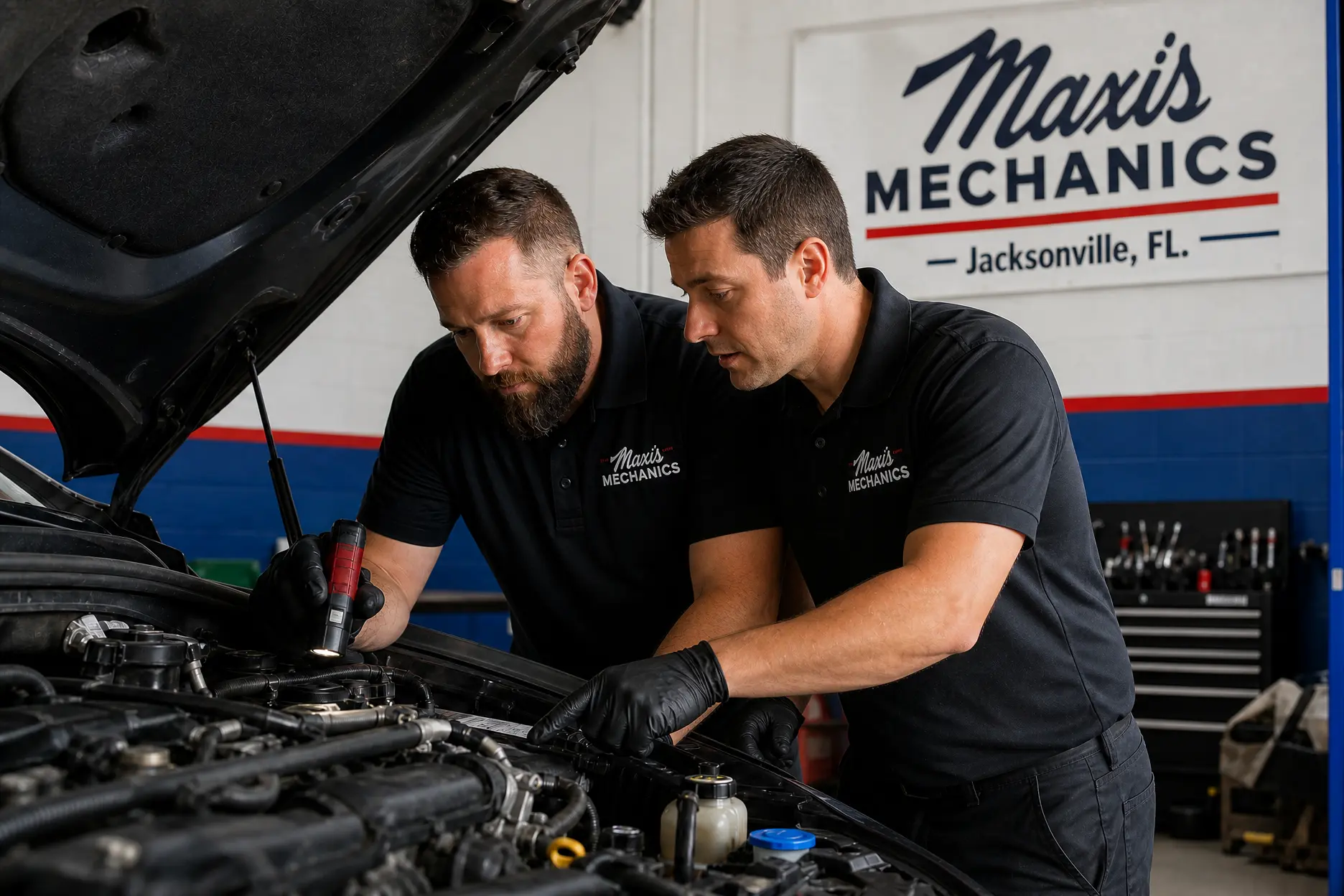
A car diagnostic test connects a scan tool to your vehicle’s onboard computer (OBD2 system) to retrieve trouble codes that identify malfunctions in the engine, transmission, emissions systems, and safety components. Maxi’s Mechanics in Jacksonville, FL performs comprehensive diagnostic tests using professional-grade equipment to pinpoint issues before they cause breakdowns.
A car diagnostic test reads data from your vehicle’s onboard diagnostics (OBD2) system to identify which sensors, circuits, or mechanical components are operating outside normal parameters.[1] When the check engine light illuminates or you notice performance issues, the diagnostic scan retrieves stored trouble codes that tell technicians exactly where to focus the repair. Modern vehicles contain dozens of sensors monitoring everything from oxygen levels in the exhaust to crankshaft position, and the diagnostic system flags abnormal readings with standardized five-character codes.
Written by The Team at Maxi’s Mechanics — Maxi’s Mechanics is a veteran-owned, ASE-certified auto repair shop serving Jacksonville, FL since 2003, with four locations: Beach Blvd, Riverside, Hodges, and San Marco.
What Does the OBD2 System Monitor in Your Car?
The OBD2 system continuously monitors engine performance, emissions controls, transmission operation, and safety systems through a network of 50 to 100 sensors depending on your vehicle model. The onboard computer — called the powertrain control module (PCM) or engine control unit (ECU) — receives real-time data from these sensors and compares readings against manufacturer specifications stored in its memory.[2]
Key monitored systems include the fuel injection system (air-fuel ratio, fuel pressure, injector pulse width), ignition system (spark timing, misfire detection, coil performance), emissions equipment (catalytic converter efficiency, evaporative emissions, exhaust gas recirculation), and drivetrain components (transmission shift points, vehicle speed sensors, throttle position).[3] The system also tracks coolant temperature, oil pressure, mass airflow, manifold absolute pressure, and oxygen sensor voltages to ensure optimal combustion and emissions compliance. Florida’s year-round heat puts extra stress on cooling and AC systems, making regular diagnostics especially valuable in Jacksonville’s climate.
How Do OBD2 Diagnostic Trouble Codes Work?
OBD2 trouble codes use a standardized five-character alphanumeric format where the first letter identifies the system (P for powertrain, B for body, C for chassis, U for network), the first digit indicates generic (0) or manufacturer-specific (1), and the remaining three characters pinpoint the exact fault. For example, code P0171 breaks down as P (powertrain), 0 (generic code used by all manufacturers), 1 (fuel/air metering), 71 (system too lean, bank 1).[4]
The OBD2 standard, mandated by the EPA for all vehicles sold in the United States since 1996, ensures that any scan tool can read basic trouble codes from any vehicle regardless of make or model.[1] Manufacturer-specific codes (those starting with P1, B1, C1, or U1) provide more detailed information but require brand-specific scan tools or professional equipment to interpret accurately. ASE-certified technicians use enhanced diagnostic scanners that access both generic and manufacturer codes, along with live data streams showing real-time sensor values.
What Do the Different Code Categories Mean?
Powertrain codes (P-codes) address engine, transmission, and emissions issues and represent about 80% of diagnostic trouble codes. Body codes (B-codes) cover interior functions like airbags, power windows, and climate control. Chassis codes (C-codes) relate to ABS brakes, suspension systems, and steering components. Network codes (U-codes) indicate communication failures between different vehicle modules.[2]
What’s the Difference Between Pending, Active, and Permanent Codes?
Pending codes appear when the OBD2 system detects a fault once but hasn’t confirmed it as a consistent problem; active codes indicate confirmed malfunctions that have occurred multiple times; and permanent codes represent emissions-related failures that remain stored even after clearing until the vehicle completes specific drive cycles proving the repair was successful. Understanding code status helps determine repair urgency.[5]
A pending code might result from a temporary condition like a loose gas cap or a single misfire during hard acceleration. If the condition recurs during a subsequent drive cycle, the pending code becomes active and triggers the check engine light. Active codes remain stored until cleared with a scan tool or after the vehicle completes 40 warm-up cycles without the fault recurring. Permanent codes, introduced in 2010 model year vehicles, cannot be manually erased and only disappear after the PCM confirms through built-in monitors that the emissions system is operating correctly.[4]
| Code Status | Check Engine Light | Clearing Method | Repair Priority |
|---|---|---|---|
| Pending | Off | May self-clear after 40 cycles | Monitor – address if becomes active |
| Active | On (solid or flashing) | Scan tool or 40 warm-up cycles | High – diagnose and repair promptly |
| Permanent | On | Only after repair + drive cycle completion | Urgent – emissions system failure |
| History | Off | Scan tool or battery disconnect | Low – past issue, verify not recurring |
Can You Diagnose Car Problems with a $20 Code Reader?
Consumer-grade code readers retrieve basic trouble codes and turn off the check engine light, but they lack the advanced functions professional diagnostic equipment provides — including live data streams, bidirectional controls, module programming, and access to manufacturer-specific codes. A trouble code indicates which circuit or sensor triggered the fault, not necessarily which component failed.[6]
For example, code P0128 (coolant thermostat below regulating temperature) might result from a faulty thermostat, low coolant level, a stuck-open thermostat, or a failed coolant temperature sensor. A basic code reader identifies the P0128 fault, but professional diagnostics using live data reveals actual coolant temperature versus expected values, helping pinpoint whether the thermostat isn’t closing or the sensor is reporting incorrect data. ASE-certified technicians at Maxi’s Mechanics use factory-level scan tools that access body control modules, ABS systems, transmission controllers, and other modules beyond the basic OBD2 port, providing comprehensive vehicle health assessment rather than just reading codes.
Schedule service at your nearest Maxi’s Mechanics location in Jacksonville — call (904) 646-4000 or book online at maxiautorepair.com.
What Happens During a Professional Diagnostic Service?
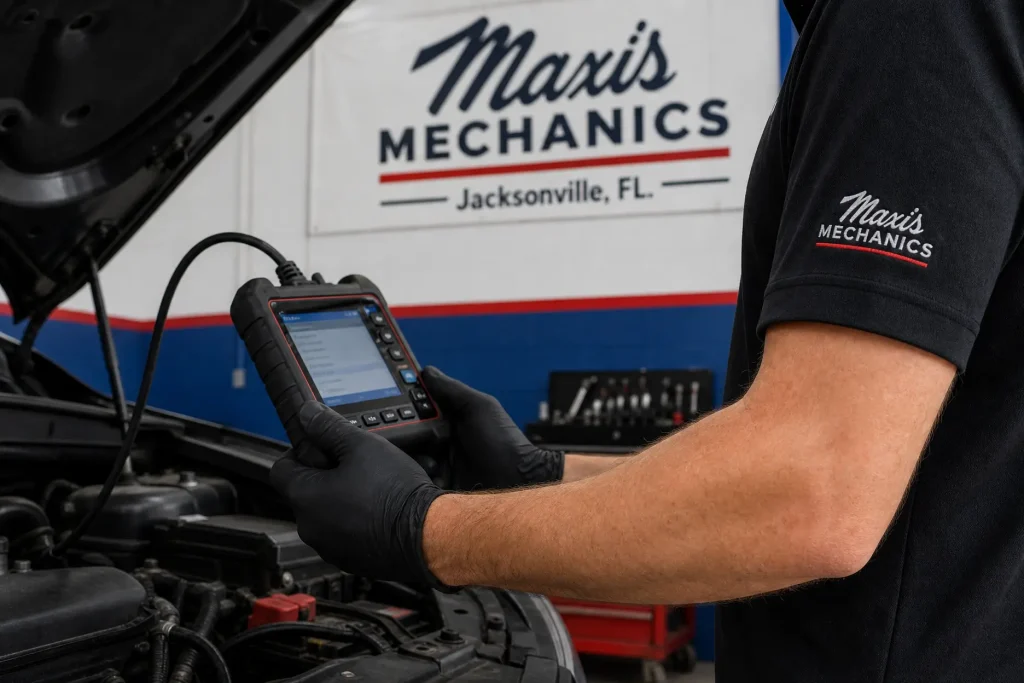
A professional car diagnostic test begins with connecting a scan tool to the OBD2 port (typically located under the dashboard near the steering column), retrieving all stored codes, reviewing freeze frame data that captures sensor readings at the moment the code set, and analyzing live data while the engine runs. The technician then performs additional tests based on the code’s guidance to confirm which component actually failed.[3]
After pulling codes, the diagnostic process includes visual inspection of related components, voltage and resistance testing of suspect sensors or circuits, comparison of live data values against factory specifications, and sometimes deliberate activation of components using bidirectional controls to verify proper operation. For intermittent problems that don’t currently show active codes, technicians may road test the vehicle while monitoring live data to capture the fault as it occurs. The diagnostic fee at most shops covers this systematic troubleshooting process, not just the 30 seconds required to plug in a scanner. Jacksonville drivers benefit from having four Maxi’s Mechanics locations offering the same thorough diagnostic approach whether you’re near the beaches, downtown, or in the Hodges or San Marco neighborhoods.
Why Does the Check Engine Light Come Back After Clearing Codes?
The check engine light returns after clearing codes because erasing stored trouble codes doesn’t fix the underlying mechanical or electrical problem that caused the code to set in the first place. The OBD2 system continuously monitors vehicle systems, and once the PCM detects the same fault again (often within minutes or a few drive cycles), it logs a new code and illuminates the warning light.[5]
Some consumers or quick-service shops clear codes without performing repairs, hoping the light stays off long enough to pass an emissions test or delay expensive work. This approach fails because modern OBD2 systems enter a “not ready” status after code clearing, requiring the vehicle to complete specific drive cycles (combinations of idle time, acceleration, highway speeds, and deceleration) before all monitors show “ready” status again.[4] Most states’ emissions testing programs reject vehicles with incomplete monitors, detecting recent code clearing. More importantly, ignoring warning lights allows minor issues like a failing oxygen sensor to cause catalytic converter damage costing $1,200 to $2,500 instead of the $150 sensor replacement.
Frequently Asked Questions
How much does a car diagnostic test cost?
Professional diagnostic services typically cost $80 to $150 depending on complexity and location. This fee covers scan tool use, code interpretation, freeze frame data review, live data analysis, and technician expertise to identify root causes beyond basic code reading. Many shops apply the diagnostic fee toward repair costs if you proceed with the recommended service.
Will AutoZone’s free code scan find all problems with my car?
AutoZone’s complimentary code reading retrieves basic powertrain codes visible through the OBD2 port but cannot access body, chassis, ABS, airbag, or transmission modules that require professional scan tools. The service identifies which code triggered your check engine light but doesn’t include diagnostic testing to determine why that code set or which component actually failed.
Can I drive with the check engine light on?
A solid check engine light indicates you can drive cautiously to a repair shop, though the vehicle may have reduced fuel economy or performance. A flashing check engine light signals active engine misfires that can damage the catalytic converter within minutes — pull over safely and arrange towing immediately to avoid turning a $200 repair into a $2,000 failure.
How long does a diagnostic test take?
Basic code retrieval takes 5 to 10 minutes, but comprehensive diagnostics requiring live data analysis, component testing, and troubleshooting often need 60 to 90 minutes. Intermittent problems that require road testing or monitoring over multiple drive cycles may take several hours or require keeping the vehicle overnight.
Do I need diagnostics if my car runs fine but the light is on?
Yes — many OBD2 codes relate to emissions system efficiency or sensor degradation that doesn’t immediately affect driveability but causes increased fuel consumption, reduced power, or component damage over time. Early diagnosis prevents $200 oxygen sensor failures from destroying $2,000 catalytic converters and helps maintain Florida’s air quality standards.
Understanding what a car diagnostic actually checks helps Jacksonville drivers make informed repair decisions and avoid costly breakdowns. At Maxi’s Mechanics, our ASE-certified technicians use professional-grade equipment to interpret trouble codes, analyze live data, and perform the systematic testing needed to accurately identify failed components. Schedule service at your nearest Maxi’s Mechanics location in Jacksonville — call (904) 646-4000 or book online at maxiautorepair.com.
Written by The Team at Maxi’s Mechanics — Maxi’s Mechanics is a veteran-owned, ASE-certified auto repair shop serving Jacksonville, FL since 2003, with four locations: Beach Blvd, Riverside, Hodges, and San Marco. Updated January 2026.
References
- U.S. Environmental Protection Agency. On-Board Diagnostics (OBD). https://www.epa.gov/state-and-local-transportation/onboard-diagnostics-obd
- Society of Automotive Engineers. J1979 E/E Diagnostic Test Modes. https://www.sae.org/standards/content/j1979_201702/
- National Institute for Automotive Service Excellence. ASE Guide to OBD-II Systems. https://www.ase.com/
- California Air Resources Board. OBD-II Specifications and Requirements. https://ww2.arb.ca.gov/our-work/programs/on-board-diagnostic-ii-obd-ii-program
- U.S. Department of Transportation. Vehicle Diagnostic Systems Overview. https://www.transportation.gov/
- Automotive Maintenance and Repair Association. Professional Diagnostic Standards. https://www.amra.org/