What causes a grinding noise when braking?
A grinding noise when braking typically indicates metal-to-metal contact between worn brake pads and rotors, requiring immediate inspection. Maxi’s Mechanics provides ASE-certified brake diagnostics and repair at four Jacksonville locations, identifying grinding brake issues quickly to prevent rotor damage and restore safe stopping power.
A grinding noise when braking means your brake pads have worn through their friction material, allowing the metal backing plate to scrape directly against the rotor. This metal-on-metal contact not only produces the distinctive grinding sound but also damages the rotor surface, turning a routine pad replacement into a more expensive rotor resurfacing or replacement job. Immediate inspection is critical — brakes grinding signals your vehicle’s primary safety system is compromised.
Written by The Team at Maxi’s Mechanics — Maxi’s Mechanics is a veteran-owned, ASE-certified auto repair shop serving Jacksonville, FL since 2003, with four locations: Beach Blvd, Riverside, Hodges, and San Marco.
Why Are My Brakes Grinding?
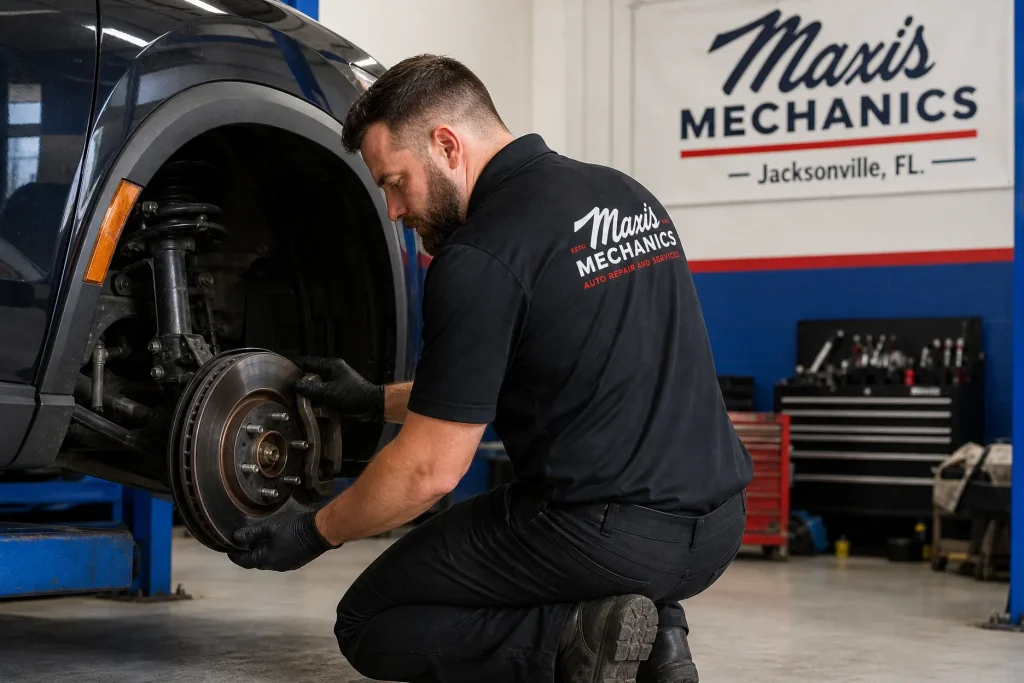
Brake grinding occurs when the friction material on your brake pads wears down completely, exposing the metal backing plate that then scrapes against the brake rotor. Modern brake pads consist of a steel backing plate bonded to friction material designed to create stopping force through controlled contact with the rotor. When that friction material erodes to less than 2mm thickness, most pads have built-in wear indicators — small metal tabs that contact the rotor and produce a high-pitched squeal as an early warning.[1] If you ignore that squeal, the pad wears through entirely, and the steel backing plate begins grinding directly on the rotor.
Brake pad lifespan varies widely based on driving habits and conditions. Highway driving with gentle braking may yield 70,000 miles from a set of pads, while stop-and-go city traffic or aggressive braking can wear pads in 25,000 miles.[2] Jacksonville drivers face particular challenges with frequent rain reducing pad-to-rotor friction and causing uneven wear, plus salt air near coastal areas accelerating corrosion. Once grinding starts, every brake application removes rotor material, creating grooves and heat damage that compromise braking efficiency and require rotor replacement alongside new pads.

What Other Issues Cause Grinding Sounds When Braking?
While worn pads cause most grinding noises, brake grinding can also result from debris trapped between the pad and rotor, rusted rotors after extended parking, or failed caliper hardware. Small rocks, road debris, or rust flakes can lodge in the brake assembly and create intermittent grinding sounds even with adequate pad material remaining.[3] This type of grinding often disappears after a few brake applications as the debris works free or gets pulverized.
Vehicles parked outdoors during Jacksonville’s humid weather often develop surface rust on rotors overnight. The first few brake applications produce a grinding or scraping sound as the pads remove this rust layer — normal and harmless if it stops within the first block of driving. Persistent grinding after the initial stops indicates a deeper problem. Caliper slide pins that seize due to dried grease cause uneven pad wear and can produce grinding on one wheel. The caliper fails to release fully, keeping partial brake pressure on one pad and accelerating wear on that side while the opposite pad remains thick.
Is It Safe to Drive With Grinding Brakes?
No, driving with grinding brakes is unsafe and should be limited only to reaching the nearest repair facility. Once metal-on-metal contact begins, your stopping distance increases significantly — the National Highway Traffic Safety Administration reports worn brakes can increase stopping distance by 20-40% compared to properly functioning brakes.[4] Every mile driven with grinding brakes causes exponential rotor damage, potentially warping the rotor from excessive heat or gouging grooves too deep for resurfacing.
The financial cost escalates quickly. A standard brake pad replacement in the Jacksonville area typically costs $150-$300 per axle depending on vehicle type. Driving with grinding brakes for even a few days often damages rotors beyond the point where machining can restore a smooth surface, requiring replacement that adds $200-$500 per axle to the repair bill. Complete brake failure, while rare, becomes possible if grinding continues long enough — the pad backing plate can separate from the caliper, eliminating braking capacity on that wheel entirely. Florida law requires all vehicles to maintain brakes in safe working condition on all wheels, and a traffic stop with audibly grinding brakes can result in a citation and mandatory inspection.[5]
| Brake Condition | Sound | Pad Thickness | Action Needed |
|---|---|---|---|
| Normal Operation | Quiet or slight whoosh | 4mm+ | Routine inspection |
| Wear Indicator | High-pitched squeal | 2-3mm | Schedule replacement soon |
| Metal Contact | Grinding/scraping | 0-1mm | Immediate service required |
| Severe Damage | Grinding + vibration | 0mm (backing plate) | Pads + rotors + possible caliper |
How Do Mechanics Fix Grinding Brakes?
Brake grinding repair requires replacing the worn pads and inspecting rotors for damage — rotors are either resurfaced to restore a smooth contact surface or replaced if wear exceeds specifications. ASE-certified technicians at Maxi’s Mechanics begin with a complete brake system inspection, measuring rotor thickness with a micrometer and checking against the vehicle manufacturer’s minimum thickness specification stamped on each rotor.[6] Rotors below minimum spec must be replaced regardless of surface condition, as insufficient material cannot safely dissipate braking heat.
If rotors meet thickness requirements but show scoring from grinding, technicians machine them on a brake lathe, removing a thin layer from both friction surfaces to create a uniform, flat contact area for new pads. Deep grooves, heat spots (visible as blue or purple discoloration), or significant runout (wobble) make rotors unsuitable for machining. The repair also includes inspecting caliper slide pins, lubricating hardware, and testing brake fluid condition. Contaminated or moisture-laden fluid reduces braking performance and requires flushing. After installation, technicians bed the new pads through a series of controlled stops that properly transfers friction material to the rotor surface and ensures optimal performance.
Schedule service at your nearest Maxi’s Mechanics location in Jacksonville — call (904) 646-4000 or book online at maxiautorepair.com.
How Can You Prevent Brake Grinding?
Preventing brake grinding requires regular inspections every 12,000 miles or annually and addressing squealing wear indicators before pad material depletes completely. Most brake pads include visual wear indicators — small grooves in the friction material that disappear as the pad wears. When you can no longer see these grooves during a tire rotation or visual inspection, the pads are approaching replacement thickness. Many vehicles also provide electronic brake wear sensors that illuminate a dashboard warning light when pads reach 3mm thickness.[7]
Jacksonville drivers should pay particular attention after heavy rain, as wet brakes temporarily reduce stopping power and may produce sounds that resolve after drying. Regular brake inspections catch wear patterns early, identifying issues like seized caliper pins or contaminated brake fluid before they cause uneven pad wear and premature grinding. Adopting smoother braking habits — anticipating stops and applying gradual pressure rather than hard, late braking — extends pad life significantly. If you hear any new brake noise, schedule an inspection within a week. The difference between a $200 pad replacement and an $800 pad-and-rotor job often comes down to responding to early warning signs rather than waiting until grinding begins.
Frequently Asked Questions
Can I just replace brake pads without replacing rotors when brakes are grinding?
No, grinding brakes have almost certainly damaged the rotor surface beyond safe use. Installing new pads on scored or grooved rotors prevents proper contact between friction surfaces, reducing braking power and causing the new pads to wear unevenly and prematurely. ASE-certified technicians measure rotor thickness and inspect for heat damage before determining whether rotors can be resurfaced or require replacement.
How long does it take to fix grinding brakes?
A standard brake pad and rotor replacement takes 1.5 to 3 hours depending on vehicle type and whether front or rear brakes need service. Most Jacksonville Maxi’s Mechanics locations can complete same-day brake repairs if you arrive early in the day, though complex jobs involving seized calipers or brake line issues may require additional time.
Will grinding brakes fail completely or just work poorly?
Grinding brakes typically continue providing reduced stopping power rather than failing completely, but the risk of total failure increases the longer you drive on worn pads. The backing plate can separate from the caliper piston, or excessive heat can cause brake fluid to boil, both resulting in partial or complete brake loss on one or more wheels.
Do rear brakes grind the same way as front brakes?
Yes, rear brake grinding follows the same wear pattern as front brakes, though rear pads typically last longer because front brakes handle 60-70% of braking force. Vehicles with rear disc brakes produce audible grinding when rear pads wear through, while drum brake systems create different sounds when shoes wear to the rivets or backing material contacts the drum.
Grinding brakes require immediate attention to prevent rotor damage and maintain safe stopping power. Don’t let a $200 brake pad replacement turn into an $800 repair — schedule service at your nearest Maxi’s Mechanics location in Jacksonville by calling (904) 646-4000 or book online at maxiautorepair.com.
Written by The Team at Maxi’s Mechanics — Maxi’s Mechanics is a veteran-owned, ASE-certified auto repair shop serving Jacksonville, FL since 2003, with four locations: Beach Blvd, Riverside, Hodges, and San Marco. Updated January 2026.
References
- National Institute for Automotive Service Excellence. Brake System Inspection and Maintenance. https://www.ase.com/
- Tire Industry Association. Brake Pad Lifespan and Replacement Guidelines. https://www.tireindustry.org/
- Motorist Assurance Program. Understanding Brake Noise and Performance Issues. https://www.motorist.org/
- National Highway Traffic Safety Administration. Brake Performance and Stopping Distance Research. https://www.nhtsa.gov/
- Florida Department of Highway Safety and Motor Vehicles. Florida Vehicle Equipment Requirements. https://www.flhsmv.gov/
- Brake Manufacturers Council. Rotor Thickness Specifications and Measurement Standards. https://www.mema.org/
- Society of Automotive Engineers. Brake Wear Indicator Systems and Standards. https://www.sae.org/