How Much Does It Cost to Replace Car Struts and Shocks?
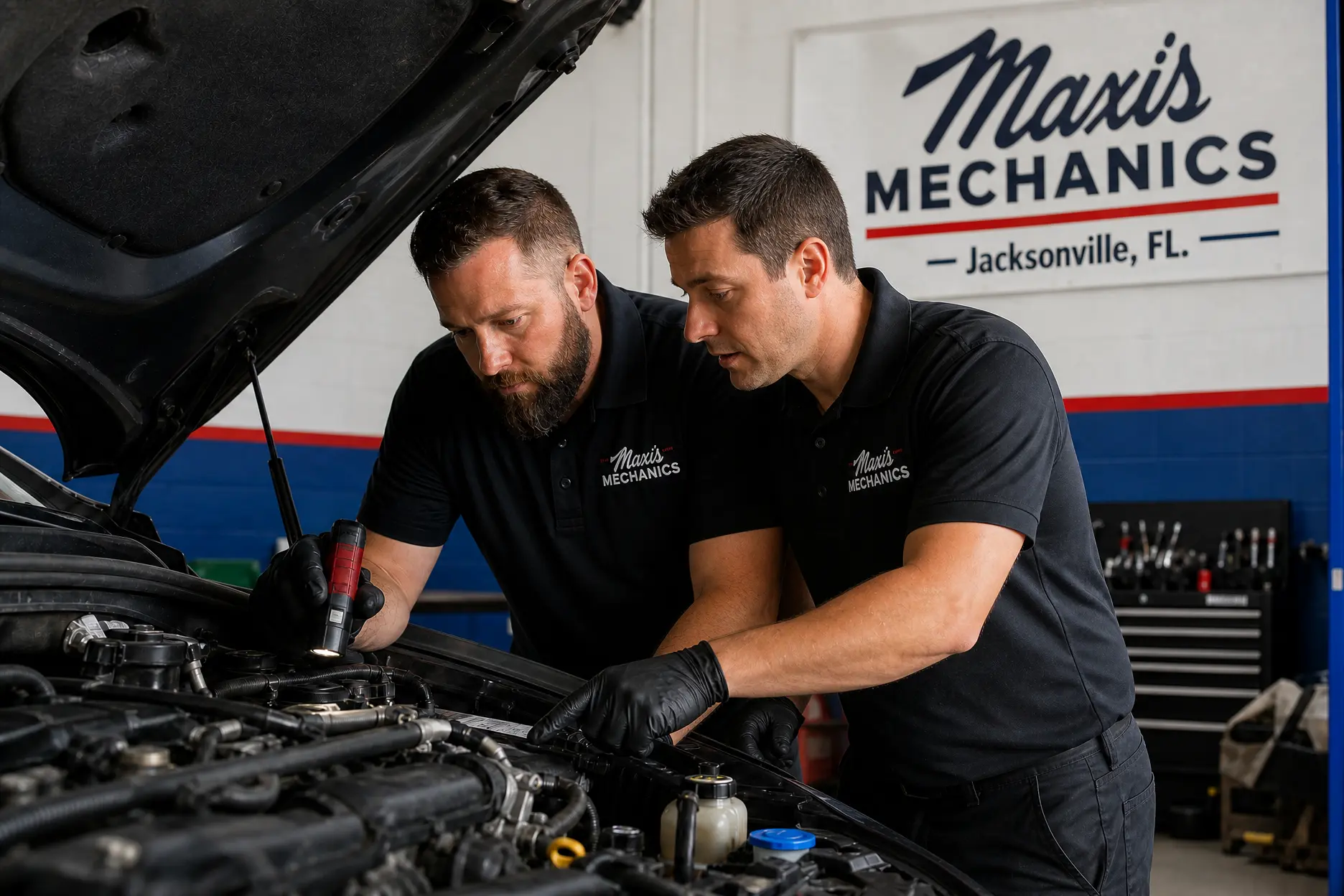
Strut replacement typically costs $400–$900 per pair including parts and labor, while shock replacement runs $250–$580 per pair. Maxi’s Mechanics in Jacksonville, FL provides transparent pricing for suspension work, with costs varying based on vehicle make, OEM versus aftermarket parts, and whether you need front or rear service.
Replacing shocks and struts costs between $250 and $900 per axle depending on your vehicle type, part quality, and labor complexity. Most passenger cars require $400–$700 for strut replacement per pair, while shock-only systems cost $250–$580 per pair. Luxury vehicles, trucks, and SUVs typically fall at the higher end due to more complex suspension designs and premium parts pricing.
Written by The Team at Maxi’s Mechanics — Maxi’s Mechanics is a veteran-owned, ASE-certified auto repair shop serving Jacksonville, FL since 2003, with four locations: Beach Blvd, Riverside, Hodges, and San Marco.
What’s the Difference Between Shocks and Struts, and Does It Affect Cost?
Struts are structural suspension components that replace the upper control arm and cost more to replace than shocks, which are standalone dampers. Most front-wheel-drive cars use struts in front and shocks in rear, while many trucks use shocks at all four corners. Strut assemblies include the spring, bearing plate, and steering pivot, requiring 2–3 hours of labor per pair. Shocks bolt directly to the frame and control arm, taking 1–1.5 hours per pair to replace.[1]
The structural role of struts means mechanics must compress springs under high tension, align steering geometry, and often perform a four-wheel alignment after installation. Shock replacement involves removing two bolts per corner with no alignment required in most cases. This labor difference accounts for $100–$200 of the cost gap between the two services.[2]
How Much Do Parts Cost for Shocks and Struts?
Aftermarket strut assemblies cost $80–$250 each, while OEM struts run $150–$400 each. Shock absorbers range from $40–$120 for aftermarket and $90–$220 for OEM per unit. Premium brands like Bilstein, KYB, and Monroe fall in the mid-range, offering better ride quality and longer warranties than budget options. Most vehicles require replacement in pairs — both front or both rear — to maintain balanced handling.[3]
| Component | Aftermarket Price | OEM Price | Labor Hours |
|---|---|---|---|
| Front Struts (pair) | $160–$500 | $300–$800 | 2–3 hours |
| Rear Struts (pair) | $140–$480 | $280–$750 | 2–2.5 hours |
| Front Shocks (pair) | $80–$240 | $180–$440 | 1–1.5 hours |
| Rear Shocks (pair) | $80–$240 | $180–$440 | 1–1.5 hours |
At Maxi’s Mechanics in Jacksonville, we stock quality aftermarket options that meet or exceed OEM specifications, giving you reliable performance without premium brand markups. Complete strut assemblies (pre-assembled with springs and mounts) cost $30–$60 more per side than bare struts but save an hour of labor by eliminating spring compression work.[4]
What Does Labor Cost for Shock and Strut Replacement?
Labor for strut replacement costs $200–$400 per pair at most shops, while shock replacement labor runs $100–$250 per pair. Jacksonville-area shops typically charge $95–$130 per hour for suspension work. Front strut jobs require removing brake components, disconnecting sway bar links and steering knuckles, and compressing coil springs — all precision work that takes time to do safely.[5]
Rear shock replacement is the quickest suspension job, often completed in under an hour per pair on trucks and body-on-frame SUVs where shocks are easily accessible. Front shocks on trucks take slightly longer due to tighter engine bay access. Luxury vehicles with adaptive or electronic suspension systems add $50–$150 to labor costs due to sensor calibration and diagnostic requirements.
What Additional Costs Should You Expect?
Four-wheel alignment costs $80–$150 and is required after front strut replacement to prevent uneven tire wear. Alignment services adjust camber, caster, and toe angles to manufacturer specifications. Some shops bundle alignment with strut installation; others charge separately. At Maxi’s Mechanics, we include a complimentary alignment check with every strut job and only charge if adjustments are needed.[6]
Related parts often need replacement during strut jobs: sway bar links ($40–$80 per pair), strut mounts ($30–$70 each), and bump stops ($15–$35 each). Corroded bolts, seized hardware, and rust penetration in Florida’s humid climate can add 30–60 minutes of labor on vehicles over ten years old. Shops typically discover these issues during disassembly and call for approval before proceeding.
How Do Vehicle Type and Driving Conditions Affect Cost?
Compact cars average $400–$650 for front strut replacement, mid-size sedans run $500–$750, and full-size trucks or SUVs cost $650–$1,100 per axle. European luxury brands like BMW, Mercedes, and Audi use more expensive OEM parts and require specialized tools, pushing total costs 30–50% higher than domestic or Asian vehicles. Heavy-duty truck shocks with remote reservoirs or adjustable damping cost $150–$300 each compared to $50–$100 for standard shocks.[7]
Jacksonville drivers face unique conditions that impact suspension lifespan: humidity accelerates corrosion on strut shafts and shock bodies, while frequent beach trips expose undercarriage components to salt. Potholes on I-95 and Beach Boulevard create repetitive impacts that fatigue shock valving faster than highway-only driving. Most Florida vehicles need shock or strut replacement every 50,000–70,000 miles versus the national average of 70,000–90,000 miles.[8]
Schedule service at your nearest Maxi’s Mechanics location in Jacksonville — call (904) 646-4000 or book online at maxiautorepair.com.
When Should You Replace Shocks and Struts?
Replace shocks or struts when you notice excessive body roll in turns, nose-diving during braking, or fluid leaking from the shock body. Other warning signs include cupped or scalloped tire wear patterns, longer stopping distances, and a bouncy ride over bumps. The bounce test — pushing down hard on each corner and watching for more than 1.5 bounces — indicates worn dampers that can’t control spring oscillation.[1]
Mechanics evaluate struts and shocks during routine maintenance by inspecting for oil seepage, checking mounting hardware for play, and test-driving the vehicle over rough pavement. Visible fluid on the shock body means internal seals have failed, allowing pressurized gas and hydraulic oil to escape. Once a shock or strut leaks, it loses 40–60% of its damping ability within weeks, compromising vehicle control and braking performance.
Ready to restore your ride quality? Schedule service at your nearest Maxi’s Mechanics location in Jacksonville — call (904) 646-4000 or book online at maxiautorepair.com.
Written by The Team at Maxi’s Mechanics — Maxi’s Mechanics is a veteran-owned, ASE-certified auto repair shop serving Jacksonville, FL since 2003, with four locations: Beach Blvd, Riverside, Hodges, and San Marco. Updated January 2026.
Frequently Asked Questions
Can I replace just one strut or shock instead of a pair?
Replacing only one side creates uneven damping that causes the vehicle to pull during braking and handle unpredictably in turns. Shocks and struts wear at similar rates on the same axle, so the opposite side is near failure even if it’s not leaking yet. Always replace in pairs.
How long does shock and strut replacement take?
Front strut replacement takes 2–3 hours for both sides including alignment. Rear shocks take 1–1.5 hours per pair. Most shops complete strut jobs in half a day, while shock-only replacement is often same-day service.
Do I need an alignment after replacing rear shocks?
Rear shock replacement on most vehicles does not require alignment because shocks don’t affect suspension geometry. Front strut replacement always requires alignment because removing the strut changes camber and caster angles. Some trucks with adjustable rear suspension may need four-wheel alignment after rear shock work.
What’s the difference between quick-struts and regular strut replacement?
Quick-struts are pre-assembled units with the spring, mount, and bearing already installed, costing $30–$60 more per side but saving an hour of labor. Regular strut replacement reuses your existing springs and requires a spring compressor. For vehicles over 100,000 miles, quick-struts are often the better value.
Will new shocks or struts improve my gas mileage?
New shocks and struts can improve fuel economy by 1–2% by reducing excessive body motion and maintaining optimal tire contact with the road. Worn suspension causes the engine to work harder to stabilize the vehicle, and uneven tire wear from bad struts increases rolling resistance.
References
- National Highway Traffic Safety Administration. Vehicle Suspension Systems and Safety. https://www.nhtsa.gov/
- Automotive Service Association. Suspension Repair Labor Time Guide. https://www.asashop.org/
- KYB Americas. Shock Absorber and Strut Assembly Technical Specifications. https://www.kyb.com/
- Monroe Shocks & Struts. Quick-Strut Complete Assembly Installation Guide. https://www.monroe.com/
- Bureau of Labor Statistics. Automotive Service Technicians and Mechanics Wage Data. https://www.bls.gov/
- Hunter Engineering Company. Wheel Alignment Specifications and Procedures. https://www.hunter.com/
- Automotive Aftermarket Suppliers Association. Suspension Component Pricing Analysis 2025. https://www.aftermarketsuppliers.org/
- Car Care Council. Vehicle Maintenance and Inspection Intervals. https://www.carcare.org/