What causes a clicking noise when turning your vehicle?
A clicking noise when turning is most commonly caused by worn CV joints, damaged tie rod ends, or failing struts and bearings. Maxi’s Mechanics in Jacksonville diagnoses these steering and suspension issues using ASE-certified technicians and factory-grade diagnostic equipment to pinpoint the exact source of clicking sounds during turns.
A clicking noise when turning typically indicates worn CV (constant velocity) joints, particularly the outer joint that flexes during steering. This clicking sound becomes more pronounced during sharp turns and accelerates as the joint deteriorates. Other common causes include damaged tie rod ends, worn strut mounts, and failing wheel bearings, each producing distinct clicking patterns that trained technicians can differentiate during inspection.[1]
Written by The Team at Maxi’s Mechanics — Maxi’s Mechanics is a veteran-owned, ASE-certified auto repair shop serving Jacksonville, FL since 2003, with four locations: Beach Blvd, Riverside, Hodges, and San Marco.
What Are CV Joints and Why Do They Click When Turning?
CV joints connect the transmission to the wheels while allowing the axle to flex during steering and suspension travel. Front-wheel-drive and all-wheel-drive vehicles rely on these joints to transfer power smoothly through varying angles. The outer CV joint experiences the greatest stress during turns, with protective rubber boots that contain lubricating grease and prevent contaminants from entering the joint assembly.[2]
When the rubber boot tears or cracks — often from age, road debris, or impact damage — grease escapes and moisture and dirt enter the joint. This contamination causes the steel ball bearings inside to wear against their tracks, creating the distinctive clicking sound during turns. The clicking occurs because the worn bearings catch and release as the joint rotates through its range of motion. In Jacksonville’s humid climate, even small boot tears accelerate corrosion inside CV joints, making early detection critical.[3]
How Do Tie Rod Ends Cause Clicking Sounds When Turning the Wheel?
Tie rod ends connect the steering rack to the wheel spindles, and when their ball-and-socket joints wear out, they produce clicking or popping sounds during steering input. Unlike CV joint clicks that occur during vehicle movement through a turn, tie rod clicking often happens while the vehicle is stationary or moving slowly, particularly noticeable when turning the steering wheel while parking.[4]
Worn tie rod ends develop excess play in their sockets, allowing the metal components to knock against each other. This wear typically results from normal mileage accumulation, exposure to road salt and moisture, or impact from potholes. Jacksonville drivers frequently encounter tie rod wear due to the combination of beach proximity (salt exposure) and aging infrastructure. A failing tie rod end also causes steering looseness and uneven tire wear, making it both a noise concern and a safety issue requiring immediate attention.
Can Struts and Strut Mounts Create Clicking Noises During Turns?
Worn strut mounts — the bearings and rubber isolators that connect the strut to the vehicle body — commonly produce clicking or clunking sounds when turning, especially over bumps. The upper strut mount contains a bearing plate that allows the strut to rotate with the steering input. When this bearing wears or the rubber mount deteriorates, metal-on-metal contact creates audible clicks.[5]
Front strut mounts experience constant stress from supporting vehicle weight while accommodating steering movement and suspension travel. Florida’s heat accelerates rubber component degradation, causing mounts to crack and compress unevenly. A failing strut mount often produces clicks most noticeably during slow-speed turns in parking lots, sometimes accompanied by a grinding sensation through the steering wheel. Technicians test strut mounts by turning the steering wheel while the vehicle is stationary and listening for noise from the upper shock tower area.
What Role Do Wheel Bearings Play in Turning Noise?
Failing wheel bearings typically produce a humming or grinding sound rather than distinct clicks, but severely worn bearings can click during turns when lateral forces shift the damaged races. Wheel bearings allow the wheel hub to rotate smoothly while supporting the vehicle’s weight and handling cornering forces. When bearings develop pitting or spalling on their inner surfaces, they create noise that changes pitch and volume during turns.[6]
A damaged wheel bearing usually announces itself with increasing noise proportional to vehicle speed, growing louder during turns that load the affected bearing. During a right turn, weight transfers to the left wheels, loading the left-side bearings more heavily. If the left bearing is worn, the noise intensifies; if the right bearing is failing, the noise may temporarily decrease. Jacksonville’s coastal environment contributes to bearing corrosion, particularly when hub seals fail and allow saltwater intrusion during beach trips or flooding events.
| Component | Click Timing | Additional Symptoms | Risk Level |
|---|---|---|---|
| CV Joint | During turn movement, speed-dependent | Grease on wheel, vibration | High — can fail suddenly |
| Tie Rod End | While steering, even when stationary | Loose steering, tire wear | Critical — steering safety |
| Strut Mount | Over bumps during turns | Clunking, steering binding | Moderate — affects handling |
| Wheel Bearing | Constant hum, changes in turns | Grinding, wheel play | High — wheel separation risk |
Schedule service at your nearest Maxi’s Mechanics location in Jacksonville — call (904) 646-4000 or book online at maxiautorepair.com.
How Do Technicians Diagnose the Source of Clicking Noises?
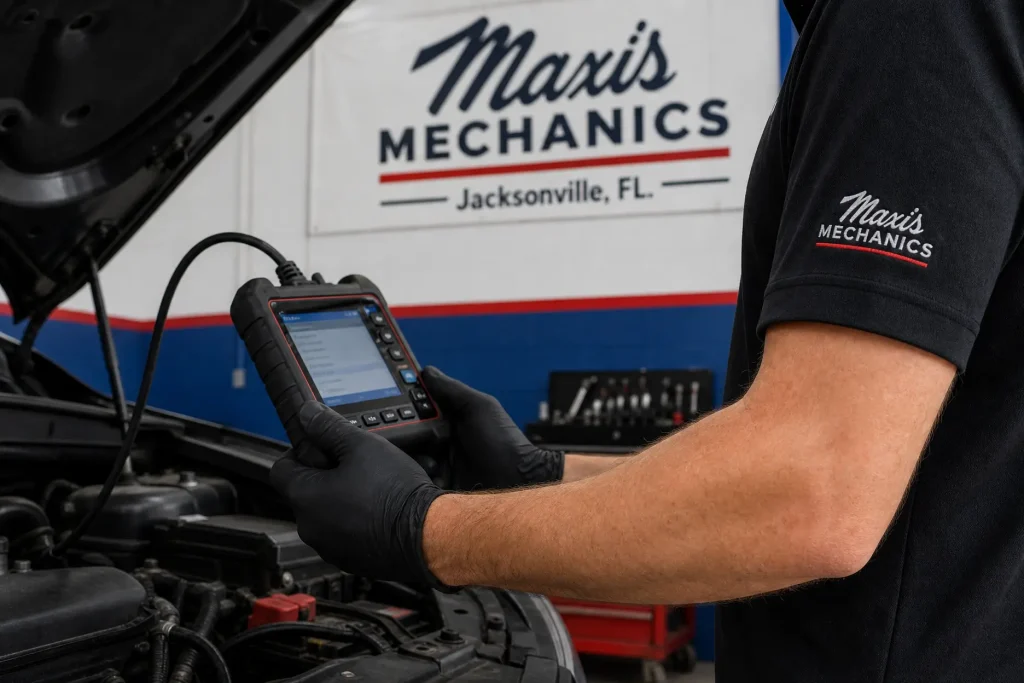
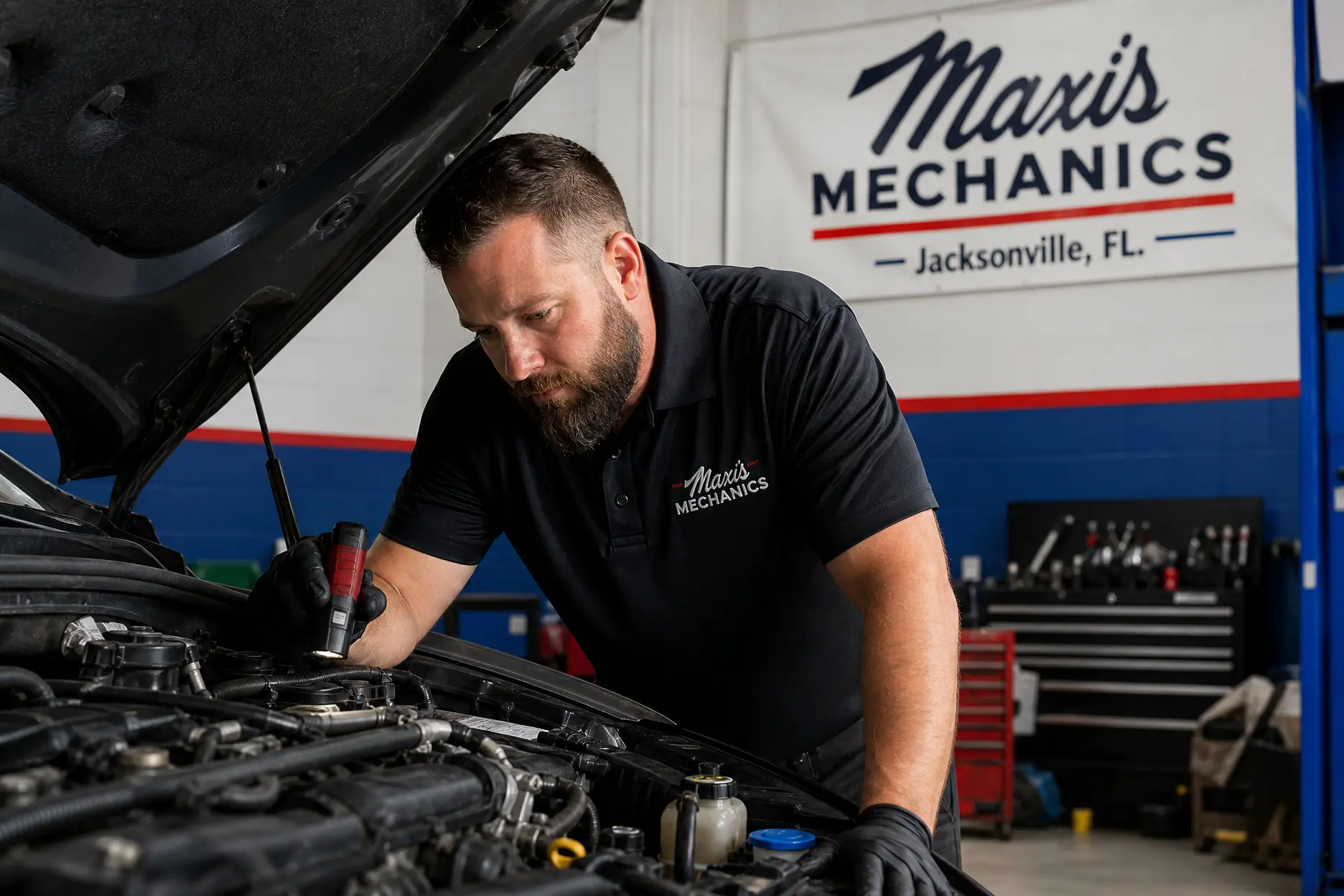
ASE-certified technicians use a systematic diagnostic process combining test drives, visual inspection, and hands-on component testing to isolate clicking noise sources. The diagnostic process begins with a detailed interview about when the noise occurs — speed, turn direction, road conditions — followed by a test drive to reproduce the symptom. Technicians listen for noise characteristics: rhythmic clicks synchronized with wheel rotation suggest CV joints, while steering-input clicks point to tie rods or struts.[7]
During lift inspection, technicians examine CV joint boots for tears, grease leaks, and axle play. They check tie rod ends by grasping the component and feeling for excessive movement in the socket. Strut mounts are tested by turning the steering wheel while observing upper mount movement and listening for noise at the shock tower. Wheel bearings receive testing by rotating the wheel by hand and checking for roughness or play. At Maxi’s Mechanics’ Jacksonville locations, this comprehensive inspection typically takes 30 to 45 minutes and includes documentation of findings with repair priority recommendations.[8]
Frequently Asked Questions
Is it safe to drive with a clicking noise when turning?
Driving safety depends on the noise source. CV joint clicking can worsen rapidly and cause axle separation, making it unsafe for extended driving. Tie rod failures directly affect steering control and present immediate danger. Have any clicking noise diagnosed promptly to determine safe driving limits.
How much does CV joint repair cost in Jacksonville?
CV axle replacement in Jacksonville typically costs between $280 and $450 per side, depending on vehicle make and whether you need the inner or outer joint replaced. Most shops replace the entire axle assembly rather than rebuilding individual joints, as modern sealed units make rebuilding uneconomical.
Can I just replace the CV boot instead of the whole axle?
Boot replacement without axle replacement only works if the boot tear is caught immediately before contaminants enter the joint. Once clicking starts, internal damage has occurred and the joint requires replacement. Boot-only repairs cost $150 to $250 but are rarely the recommended solution for clicking joints.
Why does the clicking get worse during sharp turns?
Sharp turns force CV joints and other steering components through their maximum articulation angles, amplifying any wear or damage present. The outer CV joint rotates through greater angles during tight turns, causing worn ball bearings to catch more aggressively against their damaged tracks and produce louder clicking sounds.
Don’t ignore clicking noises during turns — early diagnosis prevents costly repairs and safety hazards. Schedule service at your nearest Maxi’s Mechanics location in Jacksonville by calling (904) 646-4000 or booking online at maxiautorepair.com.
Written by The Team at Maxi’s Mechanics — Maxi’s Mechanics is a veteran-owned, ASE-certified auto repair shop serving Jacksonville, FL since 2003, with four locations: Beach Blvd, Riverside, Hodges, and San Marco. Updated January 2026.
References
- National Institute for Automotive Service Excellence. ASE Certification Study Guide: Suspension and Steering Systems. https://www.ase.com
- Society of Automotive Engineers. Constant Velocity Joints: Design, Function and Failure Modes. SAE Technical Paper Series. https://www.sae.org
- Automotive Maintenance and Repair Association. Climate Effects on Vehicle Component Longevity in Coastal Regions. https://www.amra.org
- National Highway Traffic Safety Administration. Steering System Components and Safety Inspection Guidelines. https://www.nhtsa.gov
- Automotive Service Association. Strut Mount Diagnosis and Replacement Best Practices. Technical Service Bulletin. https://www.asashop.org
- Bearing Manufacturers Association. Wheel Bearing Failure Analysis and Diagnostic Procedures. https://www.bmainfo.org
- ASE Education Foundation. Diagnostic Procedures for Noise, Vibration, and Harshness Concerns. https://www.aseeducationfoundation.org
- International Automotive Technicians Network. Front End Noise Diagnosis Flow Chart and Inspection Protocol. https://www.iatn.net