What Causes a Scraping Sound When Driving?
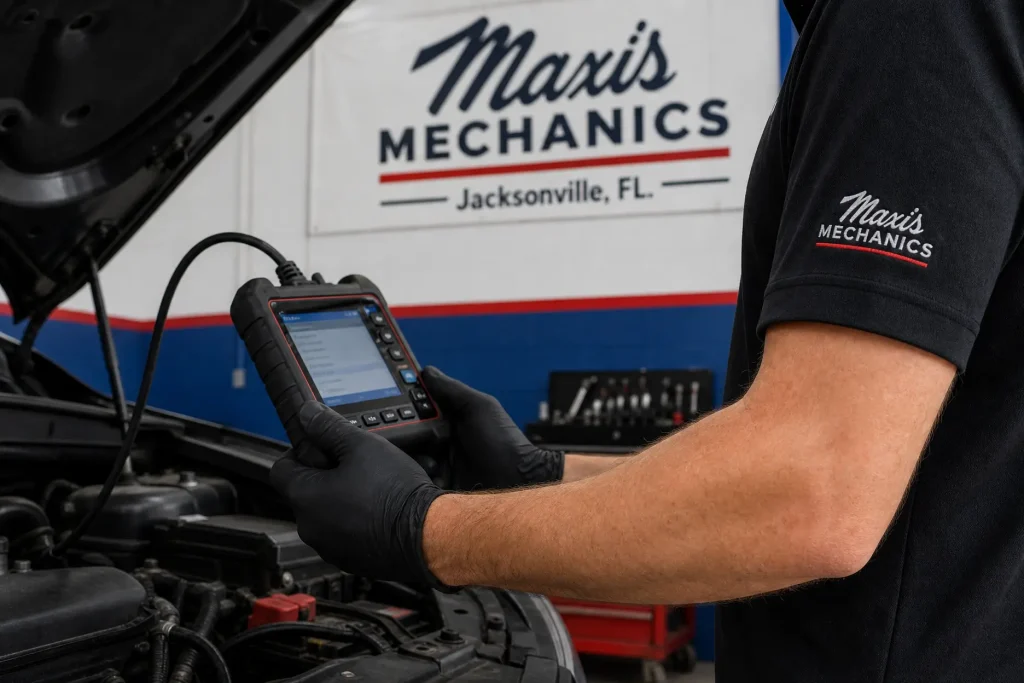
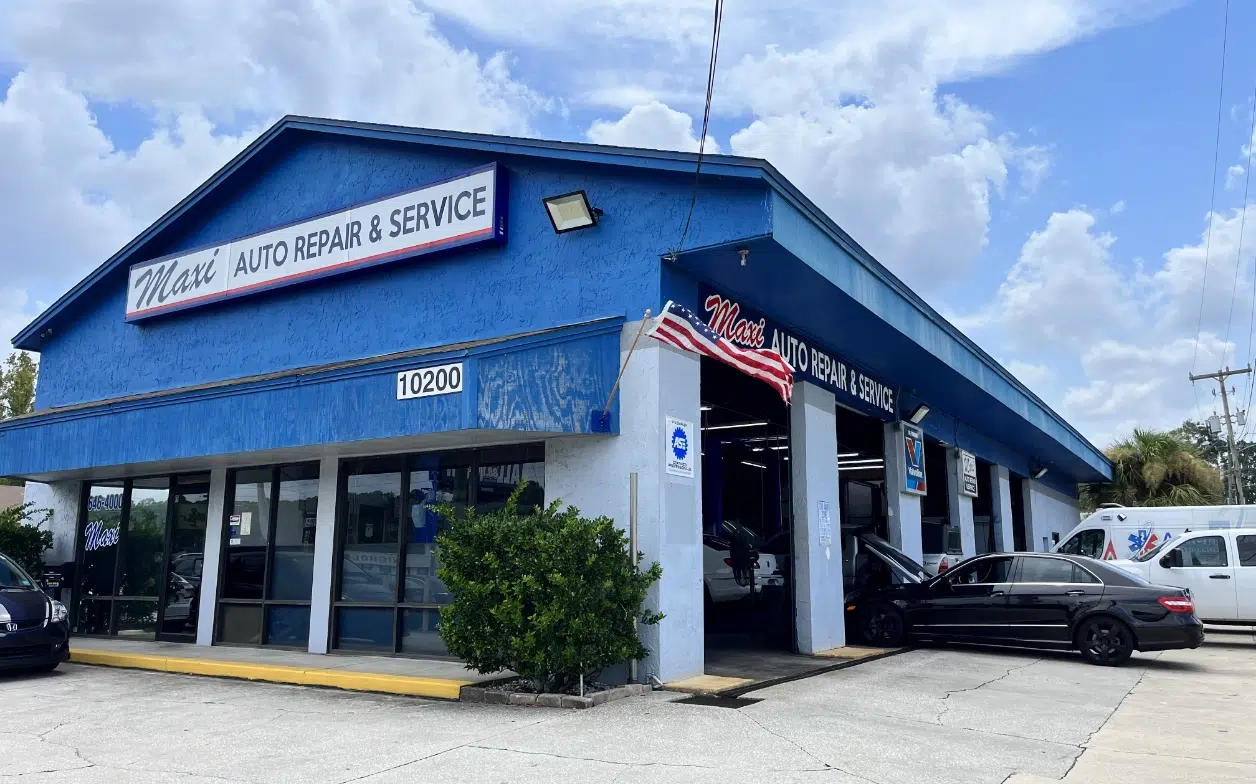
A scraping sound when driving typically results from worn brake pads making metal-to-metal contact, debris lodged near the wheels, or damaged wheel bearing shields. Maxi’s Mechanics in Jacksonville diagnoses these issues daily across our four locations, using ASE-certified expertise to identify the exact source and prevent further damage.
A scraping or grinding noise while driving usually indicates metal-to-metal contact somewhere in your vehicle’s brake, wheel, or suspension system. The most common culprits are brake pads worn down to their metal backing plates, rocks or debris trapped between the brake rotor and dust shield, or failing wheel bearings that have lost their protective seals. The sound’s characteristics — whether it’s constant or occurs only during braking, turning, or acceleration — help pinpoint the exact cause.
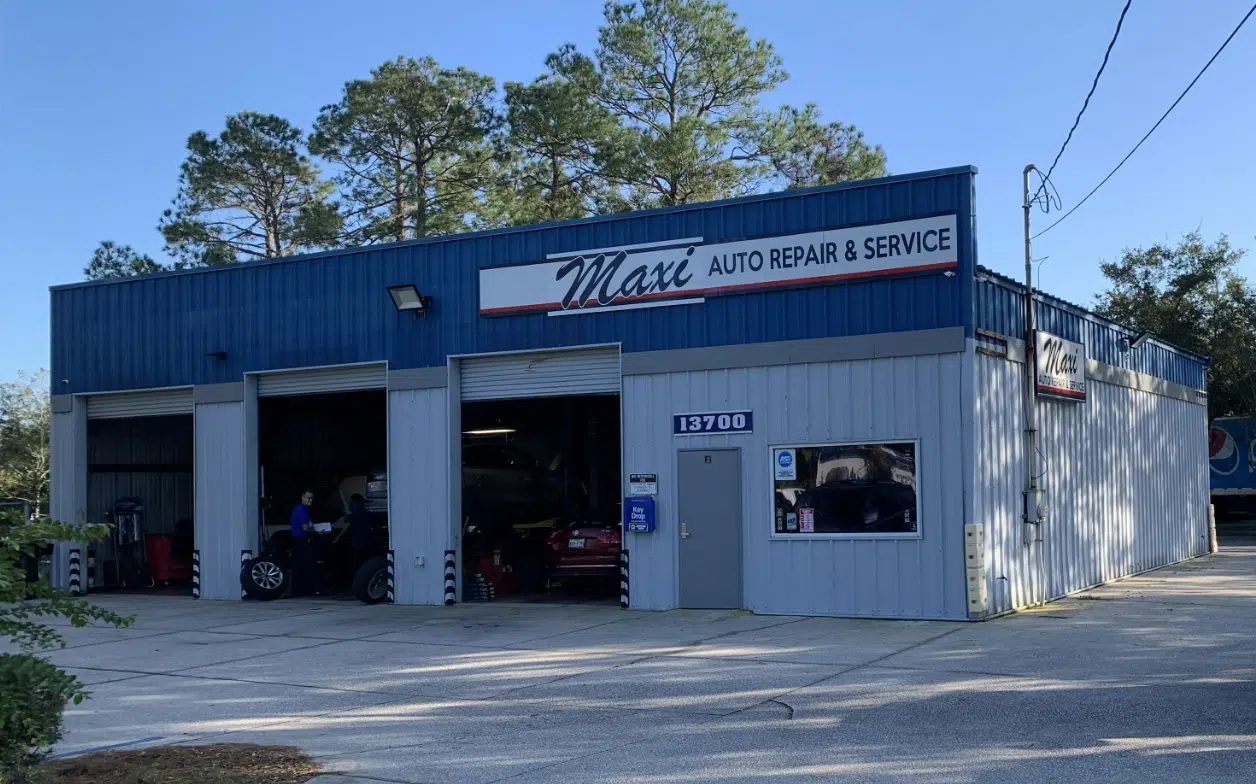
Written by The Team at Maxi’s Mechanics — Maxi’s Mechanics is a veteran-owned, ASE-certified auto repair shop serving Jacksonville, FL since 2003, with four locations: Beach Blvd, Riverside, Hodges, and San Marco.
What Are the Most Common Causes of Scraping Sounds?
The four most frequent causes of scraping sounds are worn brake pads, stuck brake dust shields, wheel bearing damage, and foreign objects lodged near rotating components. Each produces distinct sounds under different driving conditions, which helps our technicians diagnose the issue quickly.[1]
Brake pads contain wear indicators — small metal tabs designed to contact the rotor when pad material reaches 2-3mm thickness. This creates an intentional scraping sound as an early warning.[2] If ignored, the friction material wears completely away and the metal backing plate grinds directly against the rotor, producing a louder, harsher scraping noise and causing expensive rotor damage. In Jacksonville’s stop-and-go traffic, brake pads typically last 25,000-70,000 miles depending on driving habits and pad material quality.[3]
Brake dust shields — thin metal plates behind the rotors — can bend from road debris, corrosion, or improper installation after service. When bent inward just a few millimeters, they scrape against the spinning rotor. This produces a constant metallic sound that continues even when you’re not braking. Florida’s salt air and sandy roads accelerate corrosion of these shields, making this issue particularly common in coastal Jacksonville neighborhoods.
How Do I Know If the Scraping Is From My Brakes?
Brake-related scraping occurs primarily during braking and often comes with reduced stopping power, a pulsating brake pedal, or visible brake dust accumulation on your wheels. The sound typically increases in frequency as your speed increases and may be accompanied by a burning smell if the pads are severely worn.[4]
Test by applying light brake pressure at low speed in a safe area. If the scraping intensifies immediately when you press the pedal, your brake system is the source. Front brake issues usually produce noise from the front wheels, while rear brake problems create sounds from the back. Since most vehicles have front-biased braking systems that handle 60-70% of stopping force, front brake wear occurs more rapidly.[1]
Brake pad thickness should never fall below 3mm. At this point, stopping distances increase by 15-20%, and rotor damage begins.[2] Visual inspection through wheel spokes can sometimes reveal pad thickness, but a proper measurement requires wheel removal. Our ASE-certified technicians measure pad thickness during every service at all four Maxi’s Mechanics locations in Jacksonville.
Can Wheel Bearings Cause Scraping Noises?
Failing wheel bearings produce a grinding or scraping sound that changes pitch with vehicle speed and often worsens during turns. Unlike brake noise that’s intermittent, wheel bearing noise is typically constant once the bearing begins to fail. The sound may start as a faint humming and progress to a loud grinding as bearing surfaces deteriorate.[5]
Wheel bearings support the vehicle’s weight while allowing wheels to rotate freely. Each bearing contains steel balls or rollers within sealed races, protected by rubber seals and packed with grease. When seals fail — often from water intrusion, impact damage, or simply age — contaminants enter the bearing assembly and grease leaks out. This causes metal-to-metal contact between bearing components, creating grinding sounds and potentially dangerous handling issues.
A simple test: drive at 40-50 mph on a straight road, then make gentle left and right turns. If the noise intensifies during left turns, the right front bearing is likely failing (weight shifts to the outside wheel during turns). The opposite applies for right turns.[6] Wheel bearing failure requires immediate attention — continued driving can lead to wheel lockup or separation, creating serious safety hazards on Jacksonville highways.
| Sound Characteristic | Likely Cause | Driving Condition | Urgency Level |
|---|---|---|---|
| Scraping only when braking | Worn brake pads | During pedal application | High — schedule immediately |
| Constant scraping at all speeds | Bent dust shield or debris | Continuous while rolling | Moderate — schedule soon |
| Grinding that changes with speed | Wheel bearing failure | Worsens during turns | Critical — do not delay |
| Rhythmic scraping at low speed | Stuck object in wheel well | Rotation-dependent | Low — inspect when convenient |
What Other Issues Cause Metal Scraping Sounds?
Less common causes include damaged CV joint boots allowing contamination, worn suspension components making contact during compression, or exhaust system hangers that have failed and allowed pipes to drag. These issues typically produce location-specific sounds — CV joints click or scrape during tight turns, suspension noise occurs over bumps, and exhaust dragging creates constant contact sounds from underneath.[7]
Brake calipers can seize partially, causing constant pad contact with the rotor even when you’re not braking. This creates heat buildup, accelerated pad wear, and a scraping sound accompanied by reduced fuel economy and pulling to one side. Caliper pins that lack proper lubrication or pistons that stick due to corrosion are common culprits, especially in Florida’s humid climate where rust and corrosion develop quickly on brake components.
Foreign objects — rocks, plastic bags, even small branches — can lodge between wheels and bodywork or become wrapped around axles. These create intermittent scraping sounds that vary with wheel rotation. While usually not dangerous, they can damage wheel speed sensors, brake lines, or CV boots if left unaddressed during Jacksonville driving conditions where road debris is common after storms.
Schedule service at your nearest Maxi’s Mechanics location in Jacksonville — call (904) 646-4000 or book online at maxiautorepair.com.
How Urgent Is a Scraping Sound When Driving?
Any persistent scraping or grinding noise requires professional inspection within days, not weeks — brake and bearing failures can quickly become safety hazards. While a stuck dust shield might only cause noise, worn brake pads or failing wheel bearings compromise your ability to stop safely and maintain vehicle control.[8]
Brake pad replacement is routine maintenance, typically costing $150-300 per axle for quality pads and labor. Delaying until rotors are damaged adds $200-400 in rotor replacement costs. Waiting until calipers or brake lines are affected can push repairs past $1,000 per axle.[3] The financial impact multiplies with delay, not to mention the safety risk to you, your passengers, and other Jacksonville drivers.
Wheel bearing replacement ranges from $200-500 per wheel depending on vehicle design and whether hub assemblies must be replaced. Catastrophic bearing failure can damage spindles, control arms, and ABS sensors, potentially tripling repair costs. More critically, a seized or separated wheel bearing can cause loss of vehicle control at highway speeds — a risk no driver should take on I-95, I-295, or any Jacksonville road.
Can I drive with a scraping sound, or should I stop immediately?
If the scraping is minor and brakes feel normal, you can drive carefully to a repair shop. However, if you experience reduced braking power, steering difficulties, or the sound is extremely loud, pull over safely and have the vehicle towed to prevent further damage or safety hazards.
Why does the scraping sound only happen when I turn?
Scraping during turns typically indicates a failing wheel bearing, worn CV joint, or debris caught in the wheel well that only makes contact when steering angle changes. Turn-specific noises often point to components that experience different loads during cornering versus straight-line driving.
How much does it cost to fix scraping brake noise in Jacksonville?
Brake pad replacement averages $150-300 per axle at Jacksonville shops, while rotor replacement adds $200-400 if damage has occurred. Simple dust shield adjustments may cost only $50-100 in labor. Exact costs depend on vehicle make, pad quality, and extent of damage from delayed service.
Will scraping sounds damage my car if I wait a week to fix them?
Yes, most scraping sounds indicate metal-to-metal contact that worsens rapidly. Worn brake pads can damage rotors within days of heavy driving, potentially doubling repair costs. Failing wheel bearings can seize suddenly, creating immediate safety hazards and expensive collateral damage to suspension components.
Don’t ignore scraping or grinding sounds — they rarely resolve on their own and always worsen with time. Our ASE-certified technicians at Maxi’s Mechanics provide honest diagnostics and transparent pricing at all four Jacksonville locations. Schedule service at your nearest Maxi’s Mechanics location in Jacksonville — call (904) 646-4000 or book online at maxiautorepair.com.
Written by The Team at Maxi’s Mechanics — Maxi’s Mechanics is a veteran-owned, ASE-certified auto repair shop serving Jacksonville, FL since 2003, with four locations: Beach Blvd, Riverside, Hodges, and San Marco. Updated January 2026.
References
- National Highway Traffic Safety Administration. Brake System Maintenance and Safety. https://www.nhtsa.gov/
- Brake Manufacturers Council. Brake Pad Wear Indicators and Replacement Guidelines. https://www.mema.org/
- Motorist Assurance Program. Uniform Inspection and Communication Standards — Brakes. https://www.motorist.org/
- Car Care Council. Brake System Warning Signs. https://www.carcare.org/
- National Institute for Automotive Service Excellence. Wheel Bearing Diagnosis and Service. https://www.ase.com/
- SAE International. Wheel Bearing Performance Standards J2535. https://www.sae.org/
- Automotive Service Association. Common Vehicle Noise Diagnosis. https://www.asashop.org/
- Federal Motor Carrier Safety Administration. Brake System Inspection Criteria. https://www.fmcsa.dot.gov/